
Caribbean Leaders at UN 2026 Demand Reparations as CARICOM Relaunches Reparatory Justice Plan
Dominic Delgado
Special to the St. Croix Times
New York, NY - At the United Nations General Assembly in September 2026, Caribbean leaders brought a clear message to the world stage: reparations are not a symbolic request. They are a political, moral, and development issue rooted in centuries of exploitation.
Their demand came at a moment when the global reparations debate had new force. Months earlier, on March 25, 2026, the UN adopted a landmark resolution that described the trafficking and racialized chattel enslavement of Africans as “the gravest crime against humanity.” That language mattered. It gave sharper international recognition to what Caribbean governments, scholars, activists, and descendants of enslaved people have argued for generations.
The September speeches also followed the Third CARICOM Regional Conference on Reparations, held in Barbados from September 17 to 19, 2026. That gathering helped relaunch CARICOM’s Ten-Point Plan for Reparatory Justice and gave Caribbean leaders a shared platform as they arrived at the UN.
The result was a rare alignment of timing, diplomacy, and public pressure. The Caribbean was not asking the world to revisit the past for ceremony. It was insisting that the past still shapes debt, health, education, climate vulnerability, and economic inequality today.

Caribbean leaders made reparations a central issue at the UN
The UN General Assembly gives small states a rare global platform. In September 2026, Caribbean leaders used that platform to press one of the region’s longest-running demands: reparations from Global North nations that benefited from the transatlantic trafficking of Africans, plantation slavery, and colonial extraction.
Their message was direct. The wealth of many European and North Atlantic powers did not appear by accident. It grew in part from stolen labor, coerced production, and legal systems that treated African people as property. Caribbean societies still live with the damage of that system.
The calls at the UN focused on more than compensation. Leaders framed reparations as a broader program of repair. That includes formal apologies, education, health investment, debt relief, cultural restoration, and development support.
This made the speeches different from a narrow demand for money. They placed reparations inside the same global conversation as development finance, racial justice, climate responsibility, and the reform of international institutions.
Caribbean states have long argued that slavery and colonialism left behind deep structural harms, including:
Economies designed around extraction, not balanced development
Limited land ownership among formerly enslaved populations
Education systems shaped by colonial hierarchies
Public health burdens tied to poverty and historical neglect
Debt pressures that restrict national budgets
Cultural loss caused by forced displacement and racial domination
By raising these issues at the UN in 2026, Caribbean leaders placed reparations before the world as a present-day justice question. The point was not only that slavery was evil. The point was that the world built from it has not been repaired.
The March 25 UN resolution changed the diplomatic ground
The March 25, 2026 UN resolution gave the reparations debate new weight. Its description of the trafficking and racialized chattel enslavement of Africans as “the gravest crime against humanity” marked a striking moment in international language.
That phrase did not erase the long struggle that came before it. Caribbean intellectuals, Pan-African organizers, legal scholars, and civil society groups had spent decades forcing this history into global institutions. Still, the resolution gave governments a clearer point of reference.
At the UN General Assembly, Caribbean leaders could now argue from a stronger diplomatic position. If the international system recognizes the trafficking and enslavement of Africans in those terms, then the next question becomes unavoidable: what does repair look like?
Recognition without remedy can feel hollow. That was the pressure behind the 2026 debate.
The resolution also helped connect Caribbean claims to wider global discussions about historical injustice. Around the world, governments and institutions have begun to face questions about colonial violence, stolen artifacts, racial wealth gaps, and education systems that ignore or soften the brutality of slavery.
For the Caribbean, the issue cuts even deeper. Many nations in the region were built as plantation colonies. Sugar, tobacco, cotton, and other commodities were produced through forced labor for the enrichment of external powers. After emancipation, formerly enslaved people received little or no material repair, while many slave owners were compensated for the loss of what they called property.
That history remains one of the clearest moral contradictions in the modern world.
Acknowledging slavery as a crime against humanity raises the standard for action. It asks whether the world will match its language with repair.
The March resolution did not settle the question of reparations. It did something else. It made it harder for powerful countries to treat the issue as fringe, rhetorical, or closed.

The Barbados conference gave CARICOM a renewed mandate
Just days before the UN General Assembly speeches, Barbados hosted the Third CARICOM Regional Conference on Reparations from September 17 to 19, 2026. The timing mattered.
The conference gave Caribbean governments, national reparations committees, academics, youth voices, cultural workers, and civil society leaders a shared space to assess progress and reset priorities. It also helped build momentum behind the relaunch of CARICOM’s Ten-Point Plan for Reparatory Justice.
Barbados was a fitting venue. The country has played a visible role in debates over colonial memory, republicanism, and regional sovereignty. Hosting the conference there signaled that reparations are not a side issue for the Caribbean project. They sit close to questions of identity, governance, and development.
The conference strengthened three ideas that later echoed at the UN.
The first was unity. Small states can be dismissed when they speak alone. When CARICOM speaks as a bloc, the demand carries more political force.
The second was continuity. Reparations advocacy did not begin in 2026. The relaunch of the Ten-Point Plan built on a long regional effort that has moved through universities, community organizations, diplomatic channels, and national committees.
The third was urgency. Climate disasters, debt stress, migration pressures, and public health needs all shape Caribbean life now. Leaders argued that reparatory justice is not separate from those issues. It is part of how the region can build a fairer future.
The Barbados conference also helped sharpen the diplomatic message. Instead of offering broad moral appeals alone, CARICOM entered the UN moment with a program already on the table.
CARICOM’s Ten-Point Plan frames reparations as repair, not charity
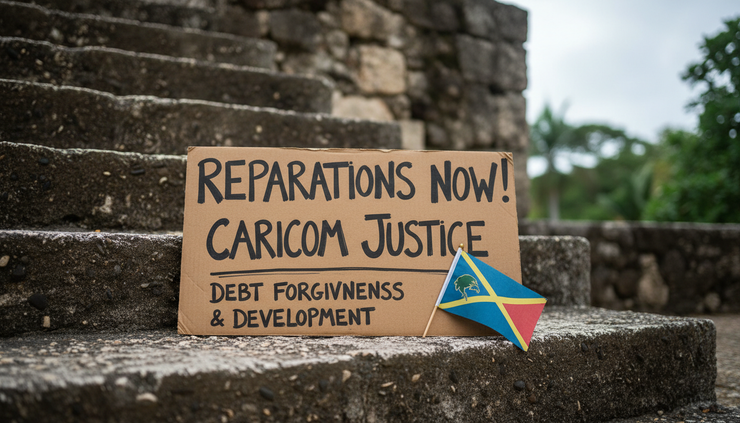
CARICOM’s Ten-Point Plan for Reparatory Justice remains one of the most developed government-backed reparations frameworks in the world. Its relaunch in 2026 gave Caribbean leaders a practical reference point as they addressed Global North nations.
The plan rejects the idea that reparations are a gesture of goodwill. It frames them as a matter of justice. It also moves beyond a single payment model and sets out a wider agenda for repairing historical and continuing harm.
Key elements include:
CARICOM demand | What it seeks to repair |
Full formal apology | Public acknowledgment of responsibility without evasive language |
Repatriation support | The right of descendants who wish to reconnect with Africa to do so |
Indigenous peoples development | Recognition of the severe harm done to Indigenous communities |
Cultural institutions | Support for museums, archives, and public memory |
Public health investment | Response to health burdens linked to poverty and colonial history |
Education and literacy programs | Repair for systems that denied equal access to learning |
African knowledge programs | Restoration of suppressed histories and cultural identity |
Psychological rehabilitation | Care for the long social effects of racial terror and dehumanization |
Technology transfer | Development support that reduces global inequality |
Debt cancellation | Relief from financial burdens tied to colonial and postcolonial structures |
This wider approach explains why the plan has remained central to Caribbean diplomacy. It gives governments a language for repair that is concrete enough to negotiate, but broad enough to reflect the scale of the harm.
The relaunch also came at a time when reparations campaigns have gained visibility beyond the Caribbean. Universities, churches, museums, banks, and governments in the Global North have faced growing demands to examine their links to slavery and colonial wealth. Some institutions have issued apologies or funded research. Others have resisted, delayed, or tried to narrow the discussion.
Caribbean leaders argued in 2026 that piecemeal gestures are not enough. A plaque, a statement, or a one-time grant cannot substitute for a serious reparatory framework.
That is why the Ten-Point Plan matters. It gives the debate a structure. It asks for institutions to move from regret to responsibility.
Why the 2026 UN moment carried unusual urgency
The Caribbean has raised reparations before. What made 2026 stand out was the convergence of events.
The UN resolution in March gave moral and diplomatic force to the language of crime and responsibility. The Barbados conference in September renewed regional coordination. The UN General Assembly then gave Caribbean leaders a global audience at the exact moment the issue had fresh momentum.
This sequence turned the phrase Caribbean Leaders at UN 2026 Demand Reparations as CARICOM Relaunches Reparatory Justice Plan into more than a headline. It captured a broader shift in how the reparations issue is being presented.
Caribbean leaders were not only speaking to former colonial powers. They were speaking to the international system as a whole.
They raised questions that reach into the structure of global politics:
Who benefited from slavery and colonialism?
Who still carries the costs?
What counts as repair when harm lasts for centuries?
Can international law recognize a crime without supporting remedy?
Can development debates ignore the history that shaped underdevelopment?
These questions are uncomfortable because they challenge familiar stories about wealth, progress, and responsibility. Many Global North nations prefer to frame slavery as a closed chapter. Caribbean leaders reject that framing because the consequences are visible in the present.
A country can abolish slavery and still inherit wealth from it. A nation can condemn racism and still benefit from structures built during racist empire. A government can express regret and still refuse repair.
That gap between words and action is where the 2026 debate gained force.
Reparations are also about the future of the Caribbean
One reason the reparations movement has lasted is that it ties memory to future-building. Caribbean leaders are not asking for history to become a museum piece. They are arguing that honest repair can help address current vulnerabilities.
Many Caribbean countries face high borrowing costs, exposure to hurricanes, narrow export bases, and limited fiscal space. These problems did not begin with slavery alone, and reparations would not solve every challenge. Still, the region’s development path was deeply shaped by colonial extraction.
Plantation economies were not designed to create broad prosperity for Caribbean people. They were designed to move wealth outward. After emancipation, the newly free were often left without land, capital, or state-backed support. Colonial rule continued to shape political and economic life long after slavery ended.
That legacy helps explain why reparations advocates speak of justice across generations. The harm was not only the original violence of enslavement, though that alone demands recognition. The harm also included the denial of wealth-building, the destruction of families, the suppression of culture, and the creation of economies dependent on distant power centers.
Repair, then, must be more than retrospective. It must strengthen the Caribbean’s ability to act with dignity and independence.
That is why debt cancellation and technology transfer sit beside apology and memorialization in the Ten-Point Plan. The plan treats memory and material conditions as linked. It says that the past lives in budgets, hospitals, classrooms, archives, and climate resilience.
The pressure now shifts to action
The September 2026 UN General Assembly did not end the reparations debate. It raised the stakes.
Caribbean leaders used the world’s most visible diplomatic forum to say that historical injustice still demands a response. The March 25 UN resolution gave that message new authority. The Barbados reparations conference gave it regional coordination. The relaunch of CARICOM’s Ten-Point Plan gave it a policy framework.
The next test belongs to the countries and institutions that benefited from slavery and colonialism. They can keep offering cautious statements, or they can enter serious talks about repair. They can treat reparations as a public relations problem, or they can treat them as a justice demand with legal, economic, cultural, and moral dimensions.
For CARICOM, the task is also demanding. Regional unity must hold. Public education must continue. National reparations committees need support. Youth participation matters, since the future of the movement depends on a generation that sees reparatory justice not as distant history, but as unfinished work.
The strongest part of the 2026 moment was its clarity. Caribbean leaders did not ask the world to feel guilty and move on. They asked the world to face a record of harm and build a serious path toward repair.
That path will not be simple. It will require negotiation, evidence, political courage, and sustained pressure. But after the UN resolution, the Barbados conference, and the General Assembly speeches, one thing is harder to deny: the reparations question is no longer at the margins of global diplomacy. It is now part of the central debate over justice in the modern world.


