
St Croix Marine Center Receives $763K Grant for New Shipyard Lift, VIEDA Study Points to STX Shipyard Future
M.A. Dworkin
St. Croix - A shipyard lift is not the flashiest piece of waterfront equipment, but it can change the kind of work an island economy is able to capture.
That is why the recent $763,401 federal shipyard grant awarded to St. Croix Marine Center matters. The funding supports a major piece of marine infrastructure: a vessel lift package with a capacity of about 165,000 pounds, tied to a 75-ton variable-width Marine Travelift. In practical terms, that gives St. Croix a stronger way to haul vessels out of the water for maintenance, repair, refit work, and storage.
The grant also points to a bigger opportunity. A feasibility study commissioned through the Virgin Islands Economic Development Authority and prepared by First Marine International highlighted St. Croix’s potential to serve as a serious commercial ship retrofitting and repair hub in the Panama Canal shipping corridor. If the new yard is designed well, it could serve working vessels and leisure craft in a space that has long needed more local capacity.

The grant funds practical infrastructure that can expand what St. Croix can service
Shipyard grants often sound technical, but the goal is easy to understand. A yard needs the right equipment to bring vessels ashore safely. Without that, owners have to travel elsewhere for major service, inspections, repairs, painting, or long-term storage.
The centerpiece in this case is a lift system described around a 165,000-pound vessel capacity, paired with a 75-ton variable-width Marine Travelift. The tonnage matters because every vessel has a haul-out limit. A marina that can only lift smaller yachts cannot handle heavier commercial craft, larger catamarans, workboats, or certain charter and ferry vessels. A yard with higher capacity can bid for more jobs and keep more marine spending close to home.
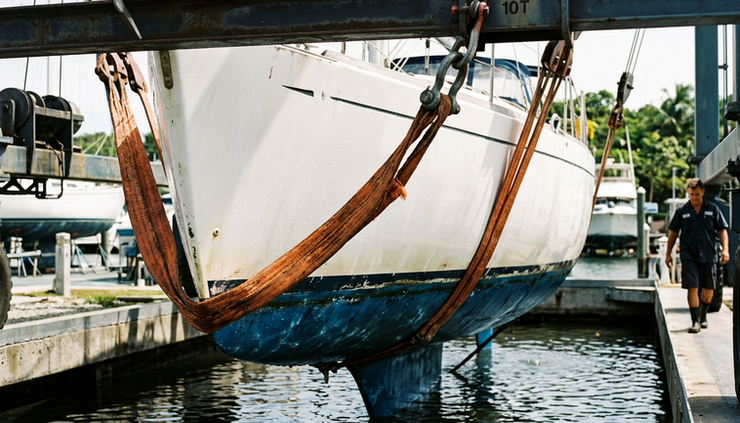
A Marine Travelift is a mobile boat hoist. It looks like a tall, rectangular gantry on giant tires. Slings hang from the top frame. Operators position the lift over a vessel while the vessel sits in a haul-out slip or basin. The slings are placed under the hull at approved lifting points, then the machine raises the vessel clear of the water.
Once lifted, the Travelift can move the vessel across the yard. Crews can set it on blocking and stands for work such as:
Bottom cleaning and painting
Propeller, shaft, and rudder service
Hull inspection and repair
Engine, electrical, and plumbing work
Storm-season or long-term storage
Commercial refit and equipment upgrades
A variable-width machine adds another layer of flexibility. Vessels do not all share the same beam, or width. Monohulls, catamarans, workboats, and specialty craft can vary widely. A lift that adjusts its width can better align with different hull shapes and lifting points. That helps the yard serve a wider mix of vessels without designing around one narrow customer type.
In a place like St. Croix, that flexibility is a business advantage. The island sees a mix of local boats, visiting yachts, inter-island commercial craft, fishing vessels, passenger vessels, and support boats. A lift that can adapt across that range gives the yard more ways to fill its schedule.
How a 75-ton Marine Travelift moves a vessel from water to yard
The haul-out process is a careful sequence. The equipment is large, but the work relies on precision.
The vessel first enters a slip designed for lifting. The water must be deep enough for the boat to float into position, and the slip must allow the Travelift to straddle the vessel. Crew members then place heavy lifting slings under the hull. Those slings connect to hoist points on the Travelift.
The operator raises the slings slowly. During the first lift, the crew checks the vessel’s balance, sling placement, hull clearance, and any underwater fittings that must not bear pressure. The goal is to support the boat at strong points, not simply lift it anywhere that seems convenient.
Once the vessel clears the water, the Travelift rolls away from the slip on large rubber tires. It carries the boat to a washdown pad, work bay, storage location, or launch area. At the work site, the vessel is lowered onto keel blocks, adjustable stands, or a cradle. The Travelift then releases the slings and moves on to the next job.
For launch, the process happens in reverse. Crews lift the boat from its supports, carry it back to the water, lower it into the slip, check for leaks and system readiness, and then release the slings.
That movement from water to land is what unlocks much of the marine repair economy. Many high-value tasks require dry access to the hull or running gear. A diver can inspect a boat underwater, but crews need a dry work surface for more involved jobs. Paint needs controlled preparation. Shafts and rudders often need clear access. Surveyors may need to see the full hull. Welding, fiberglass repair, and certain commercial retrofits need space, power, drainage, and safety controls.
A modern lift also helps with yard efficiency. Instead of relying on limited haul-out options, a site can schedule multiple kinds of work in a planned flow. A vessel can be washed, moved to a service area, blocked for repair, then relaunched when finished. That flow matters for both commercial operators and leisure boat owners because time out of service is expensive.
For a working vessel, a shorter repair window can mean fewer missed trips. For a charter or visiting yacht, it can mean staying in the U.S. Virgin Islands rather than routing to another island or Puerto Rico for service. That is where the St Croix Marine Center grant becomes more than an equipment purchase. It becomes a way to keep marine activity local.
The VIEDA study points to a larger role in the Panama Canal corridor
The federal grant fits into a wider development story. VIEDA’s feasibility study, prepared by First Marine International, identified St. Croix as having potential to become a major commercial ship retrofitting and repair hub tied to the Panama Canal shipping corridor.
That idea rests on geography and market gaps.
The Panama Canal remains one of the world’s most important maritime routes. Ships and support vessels moving through the broader Caribbean basin need places for maintenance, repair, inspection, and upgrades. Not every vessel needs a massive shipyard. Not every job belongs in a small yacht marina. Between those two ends of the market sits a valuable middle category.
St. Croix could serve that middle category if the shipyard is built with the right mix of equipment, laydown space, technical services, and access.
The island’s position in the northeastern Caribbean gives it relevance for vessels moving through regional trade lanes, charter routes, energy support activity, inter-island service, and commercial operations linked to wider shipping flows. A lift in the 75-ton class will not serve the largest ocean-going ships, but it can support a wide range of smaller commercial and specialty vessels that still need professional shipyard capability.
The First Marine International study matters because it frames St. Croix not only as a boating destination, but as a service point in a working maritime corridor. That distinction is important. Tourism brings seasonal and visitor-based activity. A repair and retrofit hub can create repeat industrial work, longer yard stays, local subcontracting, and year-round demand for skilled trades.
Commercial retrofitting can include work such as machinery changes, safety system upgrades, hull modifications, deck equipment installation, electronics improvements, and compliance-related maintenance. Repair work can cover everything from collision damage to corrosion treatment. Storage rounds out the offer, especially in a hurricane-prone region where owners may seek secure land-based options during parts of the year.
A lift alone does not create a hub. But it is one of the core tools needed to build one.
The new shipyard must bridge a real gap in the regional market
The design challenge for St. Croix Marine Center and the USVI is not simply to build a bigger marina. The opportunity is to create a yard that can serve both commercial and leisure vessels without becoming too limited for either group.
Smaller marinas often focus on yachts, pleasure boats, and day-to-day dockage. They may offer fuel, slips, basic mechanical work, chandlery services, and light maintenance. That model serves an important need, but it usually cannot handle heavier commercial craft or more involved refit projects.
At the other end, larger shipyards in Puerto Rico may offer more capacity and specialized services, but they are not always the right fit for every vessel from the U.S. Virgin Islands or wider eastern Caribbean. Moving a vessel to a larger off-island yard adds transit time, fuel costs, crew logistics, scheduling uncertainty, and lost local spending.
St. Croix can bridge that gap by designing for the middle.
A well-planned yard in this capacity range should consider:
A haul-out slip sized for varied hull types The lift area must account for monohulls, catamarans, workboats, and other beam differences.
Clear traffic flow inside the yard A Travelift needs safe turning radius, strong pavement, and direct paths between the water, washdown area, work zones, and storage.
Dedicated spaces for dirty and clean work Sanding, painting, welding, mechanical service, and electrical work each call for different safety and environmental controls.
Storm-season storage needs Caribbean boat owners often value secure land storage when storms threaten or when vessels will sit unused.
Commercial service readiness Working vessels need predictable scheduling, parts access, utility hookups, and the ability to return to service quickly.
Leisure vessel comfort without turning the site into a resort Yacht owners still need clear communication, reliable contractors, shore access, and a safe place to manage projects.

Environmental design also matters. Shipyards handle wash water, paint dust, solvents, oil, fuel, and metal waste. Modern yards need systems that protect surrounding water while allowing crews to work efficiently. Proper containment, drainage, washdown treatment, safe materials storage, and organized waste handling are not extras. They are part of being accepted by customers, regulators, and the community.
The best version of the project would feel purpose-built for St. Croix rather than copied from a much larger port. It should match local demand now while leaving room for future growth. A 75-ton variable-width lift can serve as the first major step in that direction.
Local benefits can reach beyond the shipyard fence
The most visible jobs at a shipyard are welders, mechanics, painters, lift operators, electricians, fiberglass technicians, and yard crew. Those roles matter. They are skilled, practical, and often hard to outsource once the work is on site.
But the economic impact can spread wider.
When a vessel comes ashore for repairs, owners and crews spend money nearby. They need lodging, meals, rental cars, taxis, groceries, laundry, hardware, marine supplies, and sometimes recreation while they wait. Contractors may buy materials from local vendors. Visiting boaters may extend their stay. Commercial operators may return for scheduled maintenance once they trust the yard.
That creates a wider ring of activity around the shipyard:
Marine trades and subcontractors
Parts suppliers and logistics providers
Hospitality and short-term lodging
Restaurants, bars, and grocery stores
Taxi, rental car, and transport services
Training programs and apprenticeships
Local tourism operators serving visiting crews
The job creation story is especially important for younger residents who want technical careers without leaving the island. A growing yard can support hands-on training in diesel mechanics, marine electrical systems, welding, coatings, rigging, hydraulics, composites, and lift operations. Those are portable maritime skills, but they can also anchor people at home if steady work exists locally.
Tourism can benefit as well, though in a different way than cruise calls or beach visits. Marine tourism often stretches over days or weeks. A yacht that hauls out for maintenance may bring owners, crew, captains, surveyors, and contractors. Some will spend time exploring St. Croix while the work is underway. Others may return because the island becomes part of their regular service route.
For commercial vessels, the tourism effect may be less direct, but the community impact can still be strong. Keeping repairs on island means more local purchases, more trade work, and fewer dollars leaving for competing yards.
The key benefit is not just lifting heavier vessels. It is giving St. Croix more chances to capture the work, training, and visitor spending that follow each haul-out.

A lift can be the start of a stronger maritime economy
The $763,401 grant gives St. Croix Marine Center a practical tool with strategic value. A 165,000-pound lift capability and 75-ton variable-width Marine Travelift can help the yard serve vessels that are too large or complex for smaller yacht-focused facilities, but not necessarily suited for the largest regional shipyards.
That middle ground is where St. Croix’s opportunity sits.
The feasibility work by First Marine International for VIEDA points to a future where the island plays a larger role in commercial repair and retrofitting linked to the Panama Canal corridor. The lift does not complete that vision by itself, but it helps turn the idea into physical capacity.
If the shipyard is designed with flexible haul-out space, safe work zones, environmental controls, and room for both commercial and leisure customers, it can become more than a place to park boats on land. It can become a working waterfront asset that supports skilled jobs, keeps marine spending local, and gives visiting vessels another reason to choose St. Croix.

