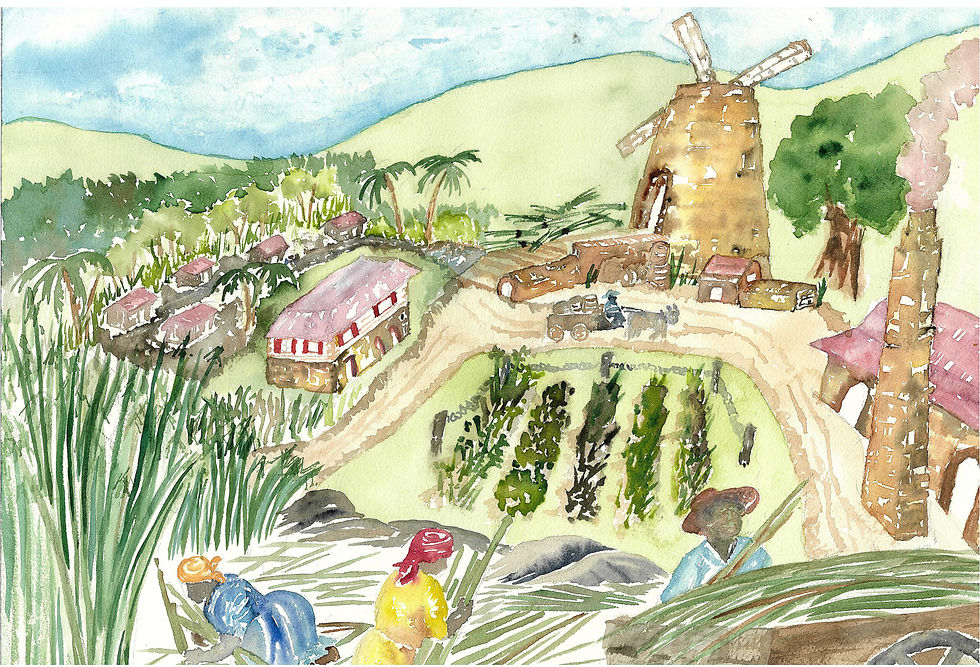
Sunday Market Square in Christiansted From Danish Roots to Revival
Updated: 7 days ago
M.A. Dworkin
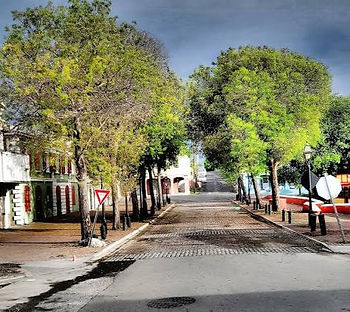
St. Croix - In the heart of downtown Christiansted, a small public square carries more than a name. Sunday Market Square, also known as Times Square, is one of those places where everyday life and deep history meet in plain sight. People pass through it, gather near it, drive around it, or recognize it by its old movie theater and central location, yet the ground itself tells a larger story about Danish colonial rule, African survival, Caribbean commerce, free speech, neglect, disaster, and renewal.
The square’s history reaches back to the earliest years of Danish Christiansted. Established between 1733 and 1735, it became part of the colonial town plan when Denmark was building its Caribbean presence on St. Croix. Over time, the square became a market, a meeting place, a point of orientation, and a civic stage.
Its story is not simple. It includes the lives of enslaved Africans who gathered there on Sundays, the only day many had away from plantation labor. It connects to Company Street, where trade shaped the town and where the young Alexander Hamilton encountered the commercial world. It later became tied to David Hamilton Jackson’s fight for a free press and labor rights. In the 1900s, it declined, then suffered further after Hurricane Hugo in 1989.
Today, new efforts led by the St. Croix Foundation, with support that includes funding from the Andrew W. Mellon Foundation, are helping residents and visitors see Sunday Market Square again as a place of memory, culture, and shared public life.
The Danish colonial roots of Christiansted’s central square
Christiansted was not a town that grew by accident. Danish colonial officials laid it out with order and purpose after Denmark took control of St. Croix in the 1730s. The town was designed as an administrative, military, and commercial center. Its grid of streets, government buildings, wharves, warehouses, churches, and public spaces served the needs of a colonial economy built on sugar and forced labor.
Within that early plan, Sunday Market Square emerged between 1733 and 1735. Its location made sense. It sat close enough to the town’s commercial streets to support trade, and central enough to serve public life. In a colonial town, a square was more than open space. It was a place where authority, commerce, and community overlapped.
The Danish West India and Guinea Company played a major role in St. Croix’s early development, and its influence shaped Christiansted’s streets and institutions. Fort Christiansvaern, the scale house, customs operations, and warehouses all tied the town to a wider Atlantic system. Sugar, rum, cotton, molasses, imported goods, and human lives moved through this system.
Sunday Market Square belonged to that same world, but its meaning changed depending on who stood there.
For colonial officials, it was a regulated space. For merchants, it helped support the local economy. For free residents, it was a place to buy, sell, and exchange news. For enslaved Africans, it became something much more personal and powerful.
Sundays gave the square its deepest meaning
The name Sunday Market Square points to one of the most important parts of its history. Under slavery, Sunday was often the only day enslaved Africans had to tend to their own needs. Plantation labor consumed the rest of the week. Sunday allowed a limited and controlled space for rest, worship, trade, family connection, and movement.
That did not make Sunday free in the full sense. Enslaved people were still living under violent systems of control. Their movement, labor, bodies, and time were constrained by law and force. Still, Sunday markets across the Caribbean became vital spaces of survival and self-expression.
In Christiansted, enslaved Africans came into town from plantations to sell provisions, handmade goods, and produce. Markets like this supported the island’s food supply, but they also supported community life.
The square made room for:
Economic activity
Enslaved vendors could sell produce, fish, poultry, charcoal, baskets, and other goods. Some used market earnings to improve daily life, support family members, or work toward freedom when that was possible.
News and communication
People from different estates could share information. In a world where enslavers tried to control speech and movement, face-to-face exchange mattered.
Cultural continuity
Market life carried African customs, foods, languages, rhythms, and patterns of exchange into the center of town. These traditions did not remain frozen. They adapted under pressure and helped shape Crucian culture.
Community gathering
Sunday was a rare chance to see loved ones, maintain kinship ties, and be recognized as part of a wider community.
This is why the square cannot be understood only as a picturesque landmark. It was a place where people built connection inside a system designed to deny it. Its history asks for attention because the most important events there were often ordinary acts of endurance: selling, greeting, listening, remembering, and returning.
Company Street linked the square to commerce and Hamilton’s early world
A short walk from Sunday Market Square leads into the older commercial heart of Christiansted. Company Street, one of the town’s key historic corridors, became a center of business during the Danish colonial era. Its name reflects the influence of the Danish company structure that shaped early St. Croix, and its role grew as Christiansted became a busy port town.
Along Company Street and nearby streets, merchants operated shops, warehouses, and counting houses. Goods moved from ships to storage rooms, from plantations to wharves, and from Christiansted to other Caribbean and Atlantic ports. The street was part of a working town where money, labor, shipping, and empire met every day.
This commercial environment also connects Christiansted to the early life of Alexander Hamilton. Before he became one of the United States’ founders, Hamilton spent formative years on St. Croix. As a young clerk, he worked in the island’s mercantile world, learning trade, credit, shipping, and correspondence. That experience helped shape the skills that later made him a force in finance and government.
Hamilton’s St. Croix years should not be romanticized. The economy that trained him was deeply connected to slavery. The ledgers, cargoes, and transactions of the period reflected a world where human bondage underwrote wealth. Christiansted’s commercial streets, including Company Street, were part of that system.
At the same time, this connection adds another layer to Sunday Market Square’s history. The square sat near the activity of trade, yet it was also shaped by the lives of people whose labor made that trade possible. Within a few blocks, Christiansted held the contradictions of the Atlantic world: opportunity and exploitation, ambition and bondage, profit and survival.
That closeness is part of what makes downtown Christiansted so historically powerful. The past is not hidden in a distant ruin. It is embedded in the streets.
David Hamilton Jackson helped turn public space into civic power
The story of Sunday Market Square did not end with Danish colonial rule or emancipation. In the early 20th century, public gathering places in St. Croix remained essential to political life. One of the central figures in that story was David Hamilton Jackson, the Crucian labor leader, journalist, and civil rights advocate.
Jackson is remembered for his work on behalf of workers and for his fight to establish a free press in the Danish West Indies. At a time when public criticism of colonial authority faced pressure and restriction, Jackson pushed for the right to publish, organize, and speak. His newspaper, The Herald, became a major voice for reform.
Public spaces mattered to that movement. Squares and streets allowed people to gather, listen, debate, and build collective strength. Sunday Market Square, with its long tradition as a meeting place, fit naturally into this civic culture. It had already served generations as a site of exchange. In Jackson’s era, exchange also meant ideas, grievances, and demands for justice.
Jackson’s legacy reminds us that the square was not only a market. It was also a place where community presence could become political presence. People gathered to hear news, discuss labor conditions, and imagine a different social order. The same kind of public space that once helped enslaved Africans maintain ties could now support organized calls for rights and reform.
That continuity matters. The square’s power came from use. It was shaped by feet on stone, voices in the air, and the repeated act of gathering together.
The 1900s brought decline, then Hurricane Hugo deepened the damage
Like many historic urban spaces, Sunday Market Square changed in the 1900s. Economic patterns shifted. Modern transportation changed how people moved through town. Commercial life spread in new directions. Buildings aged. Public spaces that had once been central to daily life became less active or less cared for.
Decline rarely happens all at once. It often shows up first in small signs: underused buildings, reduced foot traffic, lost traditions, deferred repairs, and public spaces treated more as pass-through areas than gathering places. Over time, the square’s role in Christiansted weakened.
Then came Hurricane Hugo in 1989.
Hugo struck the U.S. Virgin Islands with devastating force. Across St. Croix, homes, churches, businesses, public facilities, and historic structures suffered serious damage. The storm did not create every problem facing Christiansted, but it intensified many of them. For Sunday Market Square and the surrounding historic district, Hugo deepened physical damage and made recovery more difficult.
After major storms, communities often face hard choices. Immediate needs come first: housing, power, water, safety, and basic repairs. Historic preservation can be delayed, even when the damaged places hold deep cultural value. Years can pass while buildings remain fragile and public spaces wait for attention.
Sunday Market Square carried that burden. Its decline in the late 20th century represented more than the wear of old materials. It reflected the challenge of keeping public memory alive when economic pressure, storm damage, and limited resources meet.
Still, the square remained. That survival matters. Even when neglected, it retained its location, its associations, and its ability to become a public gathering place again.
Revitalization is bringing memory back into public life
Recent revitalization efforts have begun to reframe Sunday Market Square as a cultural and civic asset, not just a historic site in need of repair. The St. Croix Foundation has played a major role in this work, helping advance preservation, community development, and public history efforts in Christiansted.
Support from the Andrew W. Mellon Foundation has added national philanthropic backing to this local vision. Mellon’s funding has helped strengthen work focused on history, culture, and community-centered preservation. In a place like Sunday Market Square, that kind of support matters because the project is not only about fixing buildings or improving streetscape details.
The larger goal is to restore meaning.
Revitalization can help the square serve several purposes at once:
Preserve historic character
The square and nearby streets belong to one of the Caribbean’s most important colonial-era urban districts. Careful preservation helps protect that built record.
Honor African and Crucian history
The square’s story must center the enslaved and free Black communities who shaped it through labor, trade, culture, and gathering.
Support downtown Christiansted
A healthier square can strengthen foot traffic, small business activity, cultural tourism, and everyday community use.
Create space for public memory
Signs, programs, markets, performances, and educational efforts can help people understand why the site matters.
The best historic revitalization does not freeze a place in time. It allows a place to keep living while making its past visible. Sunday Market Square has always been active ground. Its renewal should continue that pattern by welcoming community life, not turning history into something distant or decorative.
A small square with a large Caribbean story
Sunday Market Square in Christiansted is easy to underestimate because it is compact. It does not need grand size to carry historical weight. Its importance comes from what happened there and from the people who gave it meaning.
Between 1733 and 1735, Danish colonial planners helped establish the square as part of Christiansted’s ordered townscape. Enslaved Africans transformed it into a Sunday gathering place where survival, trade, kinship, and culture could continue under brutal limits. Company Street and the surrounding commercial district tied it to Atlantic trade and to the world that shaped the young Alexander Hamilton. David Hamilton Jackson’s era brought another layer, linking public gathering to free press, labor rights, and civic voice.
The 1900s tested the square through decline, and Hurricane Hugo in 1989 made recovery harder. Yet the square endured. Now, with revitalization efforts led by the St. Croix Foundation and supported in part by the Andrew W. Mellon Foundation, it is being recognized again as a place where history belongs in public view.
The lesson of Sunday Market Square is clear: public places hold memory when communities continue to claim them. In Christiansted, this square is not only a reminder of what happened. It is an invitation to gather, learn, and carry the story forward.