Tim Duncan’s St Croix Roots and the St Dunstan’s Court Where a Legend Began
Axel Dash
St. Croix - Before Tim Duncan became the quiet center of the San Antonio Spurs dynasty, he was a tall kid on St. Croix learning how to compete in a place with no shortcuts. His story did not start under NBA spotlights. It started on an island with salt air, school routines, family expectations, and a basketball court that helped turn a late-blooming player into one of the most respected athletes in the game.
Duncan’s legacy is often told through championships, bank shots, and his calm expression in high-pressure moments. Those details matter. But to understand why he played with such balance, discipline, and humility, it helps to look back at St. Croix and at St. Dunstan’s Episcopal High School, where his basketball path began to take shape.

St. Croix shaped Tim Duncan before basketball did
Tim Duncan was born and raised on St. Croix in the U.S. Virgin Islands. Long before basketball became his calling, the island gave him a sense of rhythm and steadiness that followed him for the rest of his career.
St. Croix is not just a hometown note in his biography. It is part of the way people remember him. Duncan grew up in a close-knit environment where reputation came from how someone carried themselves, not how loudly they announced their talent. That matches the player he became. He rarely chased attention. He made the right play, trusted the work, and let results speak.
As a child, Duncan was first known more for swimming than basketball. He trained seriously in the pool and had the kind of size and focus that made people notice. Swimming suited him. It rewarded repetition, body control, endurance, and mental calm. Those same traits later became clear on the basketball court.
Then life changed. Hurricane Hugo hit the U.S. Virgin Islands in 1989 and damaged much of the island’s infrastructure, including swimming facilities. Duncan’s path shifted. He eventually moved toward basketball, a sport he came to later than many elite players.
That late start became part of his identity. He did not grow up with years of flashy moves built for attention. He learned the game with care. He studied footwork. He developed touch. He built habits. The result was a style that looked simple, but only because it was so refined.
Duncan also faced personal loss at a young age when his mother, Ione, died while he was still a teenager. Her influence remained central to his life. He has long been associated with a promise to value education, a promise that helped guide his decision-making even as his basketball talent grew.
Those roots mattered. The island, his family, and his early setbacks helped form the player who would later become known as “The Big Fundamental.”
St. Dunstan’s Episcopal High School gave him a place to grow
St. Dunstan’s Episcopal High School holds a special place in the story of Tim Duncan’s St Croix roots and the St Dunstan’s court where a legend began. It was not a giant sports factory. It was a school community where a young athlete could learn, adjust, and improve away from the pressure that often surrounds mainland basketball prospects.
At St. Dunstan’s, Duncan honed the basketball skills that would eventually take him to Wake Forest and then to the NBA. His rise was not instant. He had the height, coordination, and discipline, but basketball asks for timing, feel, and confidence. Those things take time.
The school setting helped. Duncan had room to make mistakes. He could learn how to receive the ball, how to use angles, how to defend without reaching, and how to finish with either hand. He could test what worked. He could measure himself against classmates and local competition. He could build a game that fit his personality.
That detail is easy to miss. Duncan did not become great by trying to play like someone else. He became great by building a style that matched his nature.
His game was calm because he was calm. His footwork was patient because he was patient. His decisions were clean because he valued control. The foundation formed early, and St. Dunstan’s gave that foundation a place to settle.
The St. Dunstan’s court was simple, direct, and demanding
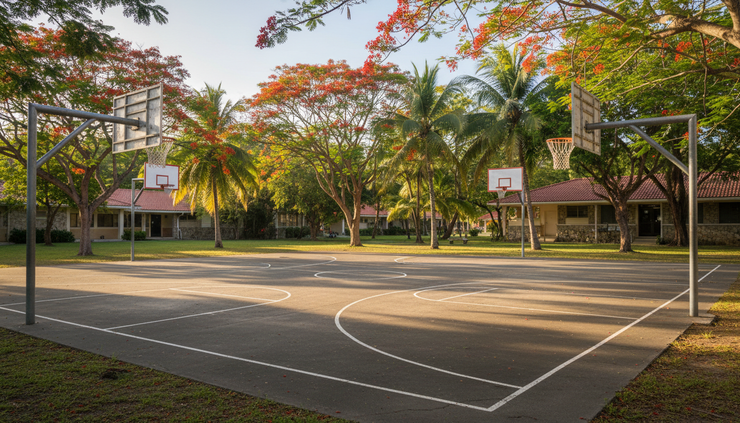
The basketball court at St. Dunstan’s was not famous because it was grand. Its meaning comes from the opposite. It was a school court, the kind of place where ability gets tested in plain conditions.
A court like that asks honest questions.
Can a player focus in the heat? Can they keep their footing on a hard outdoor surface? Can they shoot when the wind is present? Can they repeat the same move until it feels natural? Can they keep playing when there is no crowd, no camera, and no reward beyond getting better?
That is what made the St. Dunstan’s court important. It offered Duncan something more useful than comfort. It offered repetition.
The court was part of daily school life. It sat close to the rhythms of class, practice, and local play. The setting was modest, with the kind of painted lines, rims, and backboards familiar to island school gyms and outdoor courts. It was not where most people would expect an NBA legend to begin. That is precisely why it matters.
On a simple court, fundamentals stand out. A player cannot hide behind production value. The ball either goes in or it does not. A defender either stays balanced or gets beat. A rebound either gets secured or slips away.
For Duncan, that environment fit perfectly. His future greatness would never depend on flash. It would depend on foot placement, timing, discipline, and touch. The St. Dunstan’s court gave him a place to turn raw possibility into usable skill.
By the time he left the island for college basketball at Wake Forest, Duncan had more than size. He had a growing feel for the game and a foundation strong enough to carry heavier expectations.
From island prospect to Wake Forest standout
Duncan’s move from St. Croix to Wake Forest marked a major change. College basketball in the Atlantic Coast Conference brought bigger arenas, deeper scouting, and stronger opponents. It also showed how well his island-built discipline could travel.
At Wake Forest, he kept improving. He became one of the best players in college basketball and stood out for the same qualities that started forming at St. Dunstan’s. He defended. He rebounded. He passed. He scored without forcing the issue. He stayed poised.
Duncan’s game did not demand constant noise. That made it easy for some casual fans to underestimate him. Coaches and teammates knew better. His value showed up in every possession. He made teams calmer. He cleaned up mistakes. He punished bad positioning. He understood space in a way that made the game feel slower.
That link between St. Croix and the wider basketball world is a key part of his legacy. Duncan did not need to abandon where he came from to succeed. He carried it with him.
His story also expanded what people could imagine for young athletes from the Virgin Islands and the Caribbean. He proved that greatness can grow far from the usual recruiting centers. It can begin on a school court, develop through quiet effort, and reach the highest level of the sport.

The NBA saw the finished version of island-made habits
The San Antonio Spurs selected Tim Duncan with the first pick in the 1997 NBA Draft. From there, he became the centerpiece of one of basketball’s most consistent franchises.
His NBA résumé is secure. Duncan won five NBA championships with the Spurs, earned league MVP honors, became a perennial All-Star, and entered the Basketball Hall of Fame. Yet the numbers only tell part of the story.
What made Duncan different was how he won.
He did not play for highlight culture. He played for winning possessions. His bank shot became iconic not because it was flashy, but because it was dependable. His defense anchored teams. His screen setting freed teammates. His passing punished double teams. His leadership rarely required speeches.
That style made sense when viewed through his St. Croix background. Duncan played like someone who understood patience. He did not rush success. He built it.
The same traits that helped him on a school court in the Caribbean helped him in NBA Finals games. Balance. Repetition. Calm. Respect for the work.
Fans often describe Duncan as humble, but humility in sports can get misunderstood. His quiet manner did not mean he lacked fire. He competed fiercely. He simply did not need to perform emotion for everyone watching. His focus stayed on the game.
That approach influenced a generation of big players. Many young forwards and centers grew up studying his footwork, his angles, and his defensive positioning. Coaches still point to Duncan as proof that simple basketball, played with excellence, can dominate.
St. Croix remains part of the legacy
Duncan’s achievements belong to basketball history, but they also belong to St. Croix. His rise gave the island a permanent place in NBA memory. When his name comes up, so does where he came from.
That connection matters because sports legacies are not only built in arenas. They are built in homes, schools, neighborhoods, and local courts. They are built by families who support long practice hours. They are built by teachers and coaches who see potential before the world does. They are built by communities that shape a person’s character.
St. Croix gave Duncan more than a starting point. It gave him a sense of self. St. Dunstan’s gave him a place to translate that self into basketball skill. The court gave him repetition and challenge. The wider basketball world gave him a stage.
Put together, they form a rare story.
A young swimmer from the Virgin Islands loses one path, finds another, and becomes one of the greatest basketball players ever. A school court becomes part of NBA history. A quiet player from St. Croix helps define an era.

The court tells the story best
The most powerful part of Duncan’s story may be its simplicity. A court, a ball, a teenager learning late, and a set of habits strong enough to last a lifetime.
That is why the basketball court at St. Dunstan’s matters. It reminds us that legendary careers often begin in ordinary places. The setting does not need to be perfect. The work needs to be honest.
Tim Duncan’s legacy will always include San Antonio, Wake Forest, championship banners, and Hall of Fame recognition. But before all of that, there was St. Croix. There was St. Dunstan’s Episcopal High School. There was a school court where a future NBA great learned the value of calm, repetition, and trust in the basics.
The legend began there, not with noise, but with steady work.