
Why the Universe Is Stretching Not Expanding Into Space and What It Means for Cosmology
M.A. Dworkin
Outer Space and Beyond - The universe is getting bigger, but not in the way everyday intuition suggests. It is not a cloud of galaxies flying into a vast empty room. There is no known outer wall, no surrounding void, and no central point where the expansion began.
The stranger idea, and the one modern cosmology supports, is this: space itself is stretching.
That single claim changes almost everything. It affects how physicists read light from distant galaxies, how they measure cosmic history, and how they think about the ultimate fate of the universe. Recent studies of supernovas, the cosmic microwave background, galaxy clustering, and early data from large galaxy surveys keep sharpening the same unsettling picture. The universe expands because distances in space grow over time, not because galaxies are simply racing through a preexisting emptiness.

The universe is not expanding into a larger container
When people hear “the universe is expanding,” the mind reaches for familiar objects. A balloon inflates into a room. Smoke spreads through air. A drop of ink blooms in water. Each image has an outside space waiting to be filled.
The universe does not work that way, at least not in standard cosmology.
In general relativity, space is not a stage where matter performs. Space and time form a dynamic structure. That structure can curve, stretch, and evolve. When cosmologists say the universe expands, they mean the scale of space changes. The distances between faraway, unbound galaxies increase because the geometry between them changes.
This is why the phrase “the Big Bang happened everywhere” is more accurate than picturing an explosion from one point. Every region of today’s observable universe was once packed into a hotter, denser state. As space expanded, all regions moved away from one another in the large-scale pattern we now observe.
There is no special center in that picture. From almost any galaxy, distant galaxies would appear to be moving away. The farther away they are, the faster they appear to recede. This relationship is known as Hubble’s law, and it remains one of the pillars of observational cosmology.
That does not mean galaxies are blasting through space like shrapnel. Nearby galaxies can move toward each other under gravity. The Milky Way and Andromeda are on a slow collision course because their local gravity beats cosmic expansion at that scale. Galaxy clusters, solar systems, planets, and atoms do not swell along with the universe. Expansion matters most across immense distances where gravity has not bound structures together.
So the phrase Why the Universe Is Stretching Not Expanding Into Space and What It Means for Cosmology captures a critical distinction. The universe is not expanding into space. Space is part of what expands.
The rubber sheet analogy helps, but the balloon is better
Analogies are imperfect, but they can make the idea visible.
One common image is the rubber sheet analogy. Imagine drawing dots on a flexible rubber sheet. The dots represent galaxies. As the sheet stretches, the dots get farther apart. The dots do not need to crawl across the rubber. Their separation grows because the sheet between them expands.
That picture gets one key idea right: distance can increase without ordinary motion across a surface.
But the flat rubber sheet can also mislead. People may imagine the sheet stretching into a surrounding room. They may also think gravity requires a literal sag into some higher dimension, the way heavy balls deform fabric in classroom demonstrations. These models help with intuition, but they are not the thing itself.
The balloon version works better for expansion.
Picture a balloon with small dots drawn on its surface. Each dot is a galaxy. As the balloon inflates, every dot moves farther from every other dot on the surface. No dot sits at the center of the surface. No dot has to slide across the rubber. The distance grows because the surface stretches.
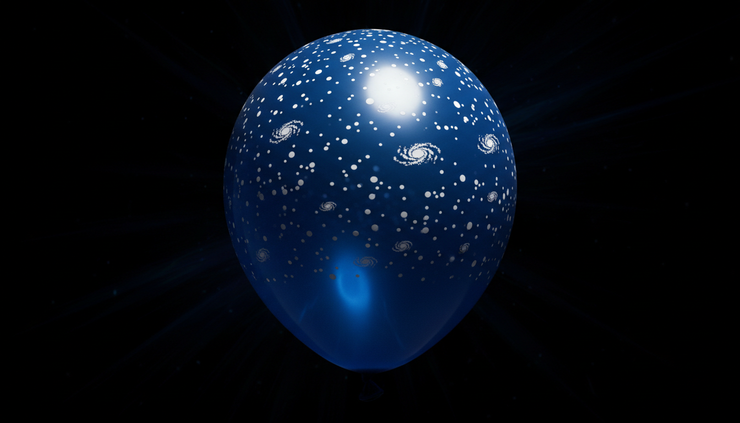
The important part is the surface, not the inside of the balloon. A two-dimensional observer living on that surface would not need to know about the surrounding room. They would simply measure that distances between faraway dots increase over time.
Our universe is not the surface of a balloon, of course. The balloon’s surface is two-dimensional, while space has three dimensions. The analogy asks us to imagine a lower-dimensional version of the same logic.
Here is what the balloon image teaches well:
There is no center on the surface
Every dot sees other dots receding.
There is no edge on the surface
If the surface is closed, a traveler can keep moving without falling off.
The dots are not causing the expansion
The stretching surface changes the distances.
More distant dots separate faster
There is more expanding surface between them.
That last point is especially important. If two dots are twice as far apart, there is twice as much balloon surface between them. When the balloon expands, more surface means more added distance. In cosmology, the same logic explains why more distant galaxies show greater recession speeds.
The analogy also explains why expansion does not require galaxies to break the speed of light in the ordinary local sense. A galaxy moving through nearby space cannot outrun light. But distant galaxies can recede faster than light due to the expansion of space between us and them. That is a feature of general relativity, not a loophole in special relativity.
What recent studies are trying to measure
Modern cosmology does not rest on one observation. Researchers compare several independent ways of measuring expansion and cosmic history.
One method uses the cosmic microwave background, the faint afterglow of the early universe. It gives a snapshot from when the universe became transparent to light. From that ancient light, cosmologists infer the universe’s contents and expansion history.
Another method uses supernovas, especially bright stellar explosions that help estimate cosmic distances. These observations led to the discovery that the expansion of the universe is speeding up, a result commonly linked to dark energy.
Galaxy surveys add another layer. By mapping where galaxies sit across huge volumes of space, scientists study patterns left by sound waves in the early universe. These patterns act like a cosmic ruler. They help trace how expansion changed over billions of years.
In recent years, large survey projects have made these maps richer. Early results have kept the standard model of cosmology mostly intact, but they also test whether dark energy behaves exactly like a constant property of space. Some analyses have raised the possibility that dark energy might vary over time, while other measurements still fit the simpler picture. The evidence is not settled enough to rewrite cosmology, but it is serious enough to keep researchers watching closely.
Then there is the Hubble tension.
Different methods of measuring the present expansion rate have not fully agreed. Measurements based on the early universe tend to give one value. Measurements based on relatively nearby objects, such as supernovas and certain stars, tend to give a higher one. The gap may come from hidden measurement issues. It may also point to missing physics.
That is why the stretching-space idea remains active science, not a finished textbook slogan. Physicists understand the basic framework well, but they still debate what drives the expansion, how dark energy works, and whether the standard model needs changes.
Why this has unsettled physicists for decades
The idea that space stretches is difficult because it removes the most comfortable mental picture. Expansion no longer looks like an explosion inside a larger arena. It becomes a change in the arena itself.
That is already strange. Dark energy makes it stranger.
For much of the twentieth century, many physicists expected gravity to slow cosmic expansion. Matter attracts matter. Over time, that pull should reduce the expansion rate. Observations of distant supernovas changed the story. They showed that cosmic expansion has been accelerating for much of recent cosmic history.
Something seems to act like a repulsive effect on cosmic scales. The name for that something is dark energy, but the name is more a label than an explanation. It may be a cosmological constant, a fixed energy associated with empty space. It may be something more dynamic. It may reveal that gravity behaves differently on vast scales than current theory predicts.
Each possibility carries consequences.
If dark energy is truly constant, the universe may continue expanding forever. Distant galaxies will slip beyond our observable horizon. Future observers in faraway eras may see a much emptier sky. The universe would not end in fire, but in distance, dilution, and cooling.
If dark energy changes over time, the cosmic future could be different. Expansion might accelerate more strongly, weaken, or behave in ways current models do not expect. Physicists avoid overclaiming here because the evidence remains under study. Still, the mere possibility affects how researchers design observations and test theory.
The unsettling part is that “empty” space may not be empty. In general relativity and quantum field theory, the vacuum is not simply nothing. Yet attempts to calculate vacuum energy from known physics famously fail to match the dark energy inferred from cosmology. The mismatch is one of the deepest unsolved problems in theoretical physics.
This is why cosmic expansion keeps pulling together people who study gravity, particle physics, astronomy, and mathematics. The biggest questions are connected:
What is space made of, if that phrase even makes sense?
Why does the vacuum appear to have energy?
Is general relativity complete on the largest scales?
Did the early universe expand in a rapid inflationary phase?
Are current tensions in the data signs of new physics or hard-to-find errors?
No single recent study has answered these questions. But each better map, each sharper supernova sample, and each improved measurement narrows the space of possible answers.
The broader consequences are almost philosophical
Cosmic expansion changes the meaning of place.
If every distant galaxy recedes from every other distant galaxy, then the universe has no preferred location. Earth is not central. The Milky Way is not central. No galaxy gets the special seat. This extends the Copernican lesson that began with moving Earth away from the center of the solar system.
It also changes the meaning of time. Looking far into space means looking back in time because light takes time to travel. A galaxy billions of light-years away appears as it was when its light began the journey. The expansion of space stretches that light while it travels, shifting it toward redder wavelengths. This redshift lets astronomers reconstruct the history of expansion.
The deeper the observation, the more the universe becomes a layered record. Nearby galaxies show recent cosmic history. Distant galaxies show younger ages. The cosmic microwave background shows an even earlier stage. Together, these layers form a timeline, not just a map.

The concept also changes what “observable universe” means. The observable universe is not the whole universe. It is the region from which light has had time to reach us since the hot early state. Because space has expanded during that time, the most distant observable regions are now far beyond the simple distance light would travel in a static universe.
Beyond that horizon may lie more universe, perhaps much more. We cannot assume an edge just because we face an observational limit. The limit belongs to what light can show us.
This has a humbling effect. Cosmology is full of measurements, equations, and instruments, but it keeps pointing to a reality larger than direct access. Scientists can test models against signals that reach us. They can use those signals with remarkable precision. Yet some questions may remain bounded by horizons built into spacetime itself.
That does not make the science weaker. It makes the discipline careful. Good cosmology separates what observations show, what equations imply, and what remains unknown.
What stretching space means for the future of cosmology
The next phase of cosmology will likely focus less on proving that the universe expands and more on learning exactly how expansion has changed over time.
That means better galaxy maps. Better distance measurements. Better understanding of supernovas. Better models of dark matter, dark energy, and the early universe. It also means taking tensions seriously without rushing to dramatic claims.
The central idea remains both simple and profound: the universe grows because the scale of space changes. Galaxies mark that change like dots on a balloon. Light carries the record of it across billions of years. Gravity shapes it. Dark energy may drive its acceleration. Every new observation tests the same strange claim from another angle.
The universe is not expanding into an outside void. The distances inside the universe are stretching. That idea has unsettled physicists for decades because it asks them to explain not only what fills space, but what space itself is allowed to do.
And that may be the most important lesson. Cosmology is not just the study of faraway galaxies. It is the study of the rules that make distance, time, and structure possible at all.


