
Did Aliens Seed Life on Earth: Exploring Science, Einstein, and the Origins of Life
Axel Dash
Before the Jurassic Period - Life on Earth began so long ago that the oldest clues are not fossils of animals or plants, but chemical traces locked in ancient rock. Scientists can study those traces, rebuild early Earth in labs, and model chemistry on computers. Yet one question still sits at the center of it all: how did nonliving matter become life?
That question has no single accepted answer. Several ideas compete, overlap, and change as new evidence appears. Some explanations stay close to Earth, focusing on oceans, minerals, lightning, and deep-sea vents. Others look outward, asking whether life, or the ingredients for life, arrived from space.
Then there is the most controversial version: perhaps aliens, whether by accident or design, seeded early life here.
That idea sits at the edge of mainstream science. It is not the same as claiming ancient astronauts built monuments or guided civilizations. In its more serious form, it belongs to the broader family of ideas called panspermia, the possibility that life can travel between worlds. It raises hard questions about biology, physics, and the scale of the universe.
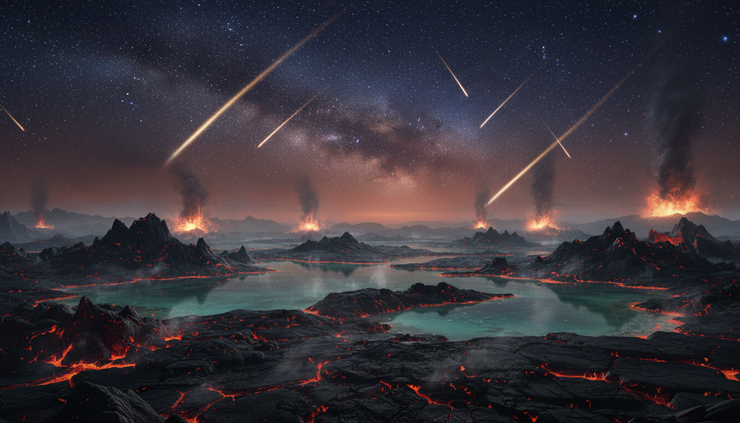
Scientists are still testing how life could start from chemistry
The traditional scientific search for life’s origin starts with a simple idea: early Earth had the raw materials and energy needed for complex chemistry. Over time, that chemistry may have produced molecules that could copy themselves, store information, and evolve.
This is often called abiogenesis, meaning life from nonlife. It does not mean a fully formed cell suddenly appeared. The more likely picture is gradual. Small chemical systems grew more complex across many steps.
A few major Earth-based ideas shape the debate.
Theory | Basic idea | Why it matters |
Primordial soup | Organic molecules formed in early oceans or ponds, helped by energy from lightning, sunlight, or heat | It gives a simple setting for early chemistry |
Hydrothermal vents | Life began near deep-sea vents where minerals, heat, and chemical gradients fueled reactions | Modern microbes thrive in similar extreme places |
RNA world | RNA may have stored information and helped chemical reactions before DNA and proteins took over | RNA still plays key roles in living cells |
Metabolism first | Networks of chemical reactions may have come before genes | It focuses on energy flow as the first step toward life |
Mineral surfaces | Clay or metal-rich minerals may have helped molecules organize and react | Surfaces can guide chemistry in ways open water cannot |
The famous Miller-Urey experiment in the 1950s gave this search a major boost. Researchers simulated a possible early atmosphere and added electrical sparks. The experiment produced amino acids, which are building blocks of proteins. The exact gases used in that experiment may not match early Earth perfectly, but the result showed something powerful: simple chemistry can become biologically interesting chemistry.
Since then, scientists have found organic molecules in meteorites, observed complex chemistry in space, and studied microbes that survive heat, pressure, radiation, salt, acid, and darkness. These discoveries do not prove how life began, but they widen the list of places where life might be possible.
The challenge is not making one useful molecule. The challenge is connecting many steps:
Making the right molecules
Concentrating them in one place
Protecting them from breakdown
Creating cycles of energy and reaction
Forming compartments like early cell membranes
Reaching heredity, where information can be copied with variation
Once heredity exists, evolution can begin. Before that point, chemistry has to do the heavy lifting.
Panspermia moves the birthplace question into space
Panspermia does not claim to explain how life began from scratch. Instead, it asks whether life could have started somewhere else and later arrived on Earth.
The idea comes in several forms. In lithopanspermia, rocks blasted from one planet by impacts carry microbes or organic material to another world. This is not pure fantasy. Meteorites from Mars have reached Earth, proving that rocks can travel between planets. Whether living cells could survive the launch, long journey, and fiery arrival is a much harder question.
Another version is cometary or meteoritic delivery. In this view, space did not bring living organisms, but it did bring key ingredients. Comets and asteroids contain water, carbon compounds, and other materials that could have enriched early Earth. This form is much easier to fit into mainstream science because it does not require living cells to survive space travel.
Then there is directed panspermia, the controversial idea that an intelligent civilization deliberately spread life to Earth or across the galaxy. Francis Crick, one of the scientists linked to the structure of DNA, and chemist Leslie Orgel discussed this possibility as a speculative hypothesis. They did not prove it, and it has not become a standard explanation. Still, the idea remains part of the wider conversation because it asks a sharp question: if life can move across space, could intelligence ever choose to move it?

Panspermia appeals to some scientists and science writers because it fits a universe filled with planets. We now know that planets are common around other stars. Many lie in zones where liquid water might exist. If life arises easily, the galaxy could be rich with biology. If life is rare, Earth may be one of the few places where chemistry crossed the line into life.
The main weakness of panspermia is that it can push the origin problem backward. If microbes came from Mars, a comet, or another star system, how did life begin there? Unless panspermia connects to a real origin process, it changes the location of the mystery rather than solving it.
The alien seeding idea is bold, but evidence must lead
The phrase “aliens seeded life on Earth” quickly attracts attention. It also attracts confusion. Serious discussion needs a clear line between testable science and unfounded claims.
A scientific alien-seeding hypothesis would need evidence. Not just mystery. Not just gaps in knowledge. It would need signs that point toward intentional action or a non-Earth biological source.
Possible evidence might include:
A biological code that strongly suggests design outside normal evolution
Life forms with chemistry sharply different from all known Earth life
Ancient material showing clear signs of artificial transport
A signal or artifact connected to biological seeding
Independent life elsewhere with a related genetic system
None of this evidence currently exists.
All known life on Earth shares deep features. Cells use DNA or RNA, proteins built from amino acids, membranes, and a genetic code. This unity suggests that all known organisms descend from a common ancestor or early community of related life forms. That does not rule out panspermia, but it does mean Earth life is deeply connected.
A major problem for directed panspermia is distance. Stars are far apart. Even the nearest star system is more than four light-years away. At ordinary spacecraft speeds, crossing interstellar space takes enormous time. Radiation, vacuum, and cosmic rays threaten living cells. Some microbes form tough spores, and experiments show life can survive harsh conditions for limited periods, especially when shielded. Interstellar survival over very long spans remains a serious barrier.
This is where physics becomes central. Biology can ask what life can survive. Chemistry can ask how molecules form. Physics asks what the universe allows.
Einstein changed the frame for cosmic life
Albert Einstein did not create a theory of the origin of life. His work does not prove or disprove aliens. The connection is more subtle and more important.
Einstein changed how science thinks about space, time, energy, and gravity. Special relativity set a cosmic speed limit: nothing with mass can travel at or faster than the speed of light. That fact shapes every serious discussion of interstellar travel. If aliens seeded Earth, they faced the same rules.
Relativity also shows that time is not universal. At speeds close to light, travelers would experience time differently from observers left behind. This effect, called time dilation, often appears in science fiction. It is also real physics. For future spacecraft moving at extreme speeds, relativity would not be optional. It would define the journey.
General relativity changed gravity from a force into the curvature of spacetime. That view helped build modern cosmology, including the study of expanding space, black holes, gravitational lensing, and the large-scale structure of the universe. Any serious search for life beyond Earth now sits inside this Einstein-shaped universe.

Einstein’s famous equation, `E = mc²`, also reminds us that matter and energy are linked on a scale far beyond everyday experience. Space travel, star formation, nuclear reactions, and cosmic radiation all make more sense through that lens.
The link between Einstein and alien-origin ideas is not that relativity supports wild claims. It does the opposite. It disciplines them. It forces better questions:
How fast could a probe travel?
How much energy would it need?
How long could microbes remain viable?
Could a civilization send self-repairing biological material?
Would natural rocks make better carriers than spacecraft?
Those questions helped push science toward astrobiology, planetary science, and the search for life in extreme environments. The alien-seeding idea may be speculative, but it has helped sharpen scientific thinking by making researchers define what is physically possible.
Speculative ideas can still shape real science
Even when scientists reject a bold idea, the act of testing it can produce useful knowledge. Panspermia and directed panspermia have influenced several areas of research, not because they are proven, but because they ask productive questions.
One area is planetary protection. If microbes can travel between worlds, spacecraft can accidentally carry Earth life to Mars, Europa, or other targets. Space agencies treat this risk seriously. Clean spacecraft are not just about engineering pride. They help protect future discoveries from contamination.
Another area is extremophile research. Microbes that live in boiling vents, acidic pools, deep rock, salty lakes, and frozen environments show that life is tougher than once assumed. These organisms expand the list of places worth searching for life.
A third area is the study of organic chemistry in space. Astronomers have detected many carbon-based molecules in interstellar clouds and star-forming regions. Meteorites also contain amino acids and other organic compounds. This supports a less dramatic but powerful idea: the universe may naturally make many of life’s ingredients.
Alien-origin theories also shaped the public imagination around SETI, the search for extraterrestrial intelligence. The idea that intelligence might communicate, travel, or seed life across space encourages scientists to think about signals, biosignatures, technosignatures, and long-term survival.
Some technology connections are indirect but real. Missions that study Mars, comets, icy moons, and asteroids need better sensors, cleaner sampling tools, stronger robotics, and more precise navigation. Relativity even matters in modern navigation systems. GPS satellites must account for time effects from both special and general relativity. That is not an alien technology, but it shows how cosmic physics turns into practical tools.
The same pattern appears across science. A big question about life in the universe leads to instruments. Instruments lead to cleaner data. Cleaner data leads to better questions.
The real debate is about evidence and imagination working together
The origin of life debate is not a fight between boring science and exciting speculation. It is a test of how well evidence and imagination can work together.
Earth-based origin theories have the strongest scientific footing because they connect directly to chemistry, geology, and biology. They can be tested in labs and compared with ancient rocks. They also fit what we know about evolution from common ancestry.
Panspermia has real scientific value when framed carefully. Rocks move between planets. Organic molecules form in space. Microbes can survive some extreme conditions. These facts make parts of the idea worth exploring.
Directed panspermia, the alien seeding version, remains much weaker. It is possible to imagine, but science needs more than possibility. It needs traces, patterns, mechanisms, and predictions that can be checked. Without those, the idea remains speculation.

Still, speculation has a role. Many scientific advances began with questions that sounded strange at first. The key is to keep the door open without removing the hinges. A good theory must welcome testing. A weak theory avoids it.
So, did aliens seed life on Earth? At this point, there is no solid evidence that they did. The best current explanations focus on natural chemistry on early Earth, possibly enriched by materials from space. Yet the alien-seeding question has value because it stretches the frame. It connects life’s origin to planets, stars, relativity, technology, and the future search for life beyond Earth.
The deeper lesson is that life may be both local and cosmic. It may have begun in a warm pond, a deep-sea vent, a mineral-rich crack in ancient rock, or on another world entirely. Each possibility changes how we see ourselves.
If life began easily on Earth, the universe may be full of living worlds. If it required rare conditions, this planet becomes even more precious. If life can travel, then biology may be part of a much larger story that crosses oceans of space.
The question remains open, and that is what makes it powerful. It asks science to be careful, bold, skeptical, and curious at the same time.


