The 7 Types of UFO Encounters: From Hynek to UAP Disclosures and the Hidden Truth
Axel Dash
The Universe - A strange light in the sky is one thing. A strange light that leaves burn marks, stops a car engine, or comes with reports of beings is something else entirely.
That difference is why UFO researchers began sorting encounters into categories. The system gave investigators a way to separate a distant sighting from a close, complex event. It also helped the public ask better questions. What was seen? How close was it? Was there physical evidence? Did anyone claim contact?
The most famous version began with astronomer J. Allen Hynek, who worked as a scientific consultant for the U.S. Air Force’s Project Blue Book. Hynek’s original close encounter scale had three kinds. Later writers and researchers expanded it to seven.
Some of those later categories are highly controversial. They rely on witness claims that are difficult to verify. Still, the seven-part model remains one of the most widely recognized ways to discuss UFO and UAP reports.

Hynek gave UFO reports a serious framework
J. Allen Hynek did not begin as a UFO believer. He was an astronomer, a professor, and a consultant to the Air Force during investigations into unidentified flying objects. His early role was often to explain sightings as stars, planets, aircraft, balloons, or weather effects.
Over time, Hynek became less dismissive. He noticed that some reports came from trained observers and resisted easy explanation. That did not mean they were extraterrestrial. It meant they deserved a more careful method.
In his 1972 book The UFO Experience, Hynek laid out a classification system. He separated distant sightings from close encounters. The term close encounter applied when the object or event seemed close enough for meaningful detail, often described as within a few hundred feet.
Hynek’s best-known categories were:
Hynek category | What it described | Why it mattered |
Close encounter of the first kind | A nearby UFO sighting with no physical trace | It focused on observation alone |
Close encounter of the second kind | A sighting with physical effects | It introduced evidence beyond testimony |
Close encounter of the third kind | A sighting involving occupants or beings | It moved the report from an object to an alleged encounter |
This structure made UFO research more organized. Instead of treating every report as equal, investigators could ask what level of claim was being made.
A blurry light above a highway did not belong in the same class as a landing trace in a field. A radar contact was different from a witness saying they saw occupants near a craft. Hynek’s system helped create those boundaries.
The seven types of UFO encounters explain rising levels of complexity
The later seven-part model builds on Hynek’s original three categories. The first three come from Hynek’s framework. The fourth through seventh are later additions used by some UFO researchers, experiencer groups, and popular writers.
They are not all accepted in the same way. The higher the number, the more extraordinary the claim and the harder it becomes to verify.
First kind sightings without physical effects
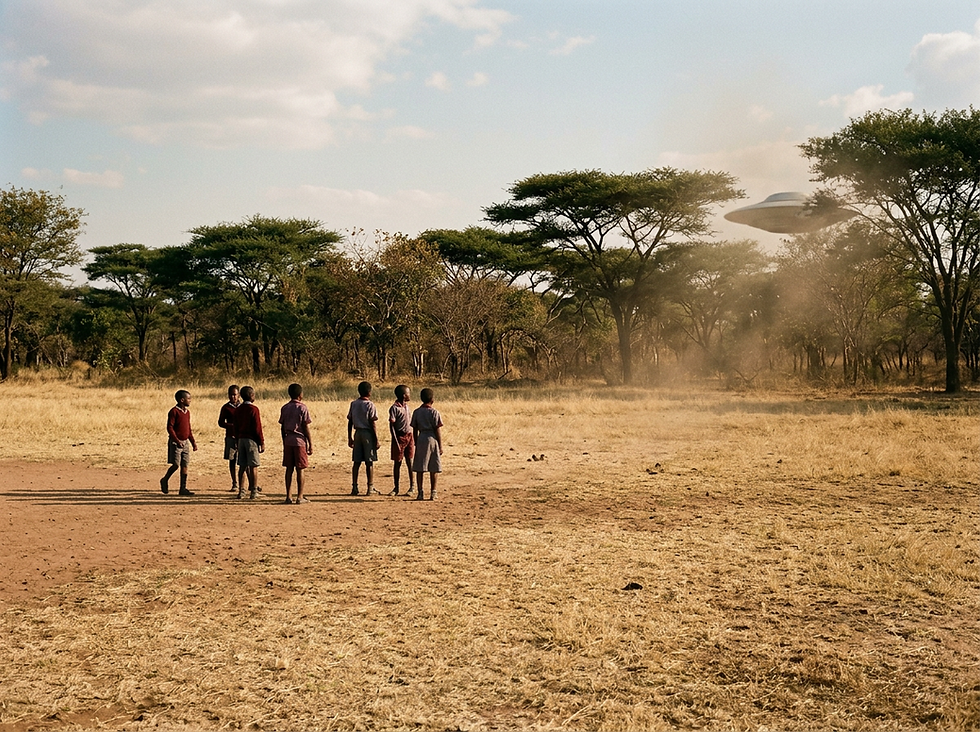
A close encounter of the first kind is the simplest category. A person sees an unidentified object at close range, but no physical effect is reported.
These reports might involve:
A silent disc moving low over a road
A bright object hovering over a field
A structured craft seen for a short time
A light making unusual movements near the witness
The key point is that the report depends mainly on observation. There are no burn marks, no landing traces, no stopped electronics, and no contact with beings.
That does not make the report worthless. Many serious UFO cases began as visual sightings. But first-kind encounters are also the easiest to misidentify. Aircraft, drones, meteors, satellites, and atmospheric effects can all look strange under the right conditions.
Second kind sightings with physical effects
A close encounter of the second kind adds a physical effect. This may include effects on the environment, animals, vehicles, or people nearby.
Common claims include:
Scorched grass or damaged plants
Circular impressions on the ground
Vehicle engines stalling
Radio or electrical interference
Animals reacting in unusual ways
Heat, pressure, or radiation-like symptoms
This category matters because it gives investigators something to inspect. A trace on the ground can be photographed. Soil can be sampled. A vehicle can be checked. Multiple witnesses can be interviewed separately.
Still, second-kind cases require caution. Physical traces can have ordinary causes. Plants can die from fungus. Engines can fail. Animals can panic for many reasons. The strongest cases are those where physical effects match witness accounts and cannot be easily explained.
Third kind sightings with beings
A close encounter of the third kind involves beings or occupants connected to the UFO event.
This is the category made famous by the phrase “close encounters of the third kind.” In Hynek’s system, it meant the witness reported seeing some kind of entity, usually near or inside the object.
Reports vary widely. Some describe small humanoid figures. Others describe tall beings, robotic shapes, or forms that are hard to classify. The details often reflect the culture and expectations of the time, which makes these accounts fascinating but difficult to assess.
Third-kind encounters raise major questions:
Did the witness see a real figure?
Was it a person, animal, shadow, or optical effect?
Did fear or surprise change the memory?
Did later retellings alter the details?
Because these reports involve beings, they often attract attention. They also demand a high level of scrutiny.
Fourth kind abductions by nonhuman intelligence
A close encounter of the fourth kind usually refers to alleged abduction by nonhuman intelligence.
This category is not part of Hynek’s original three. It grew from later abduction literature, especially accounts in which people say they were taken aboard a craft, examined, moved through missing time, or returned with fragmented memories.
The most famous abduction stories include common themes:
Missing time
Medical-style examinations
Paralysis or inability to move
Telepathic messages
Strange rooms or bright lights
Marks on the body after the event
These accounts are deeply personal and often distressing. They also sit at the edge of what evidence can prove. Sleep paralysis, trauma, suggestion, dreams, and memory distortion can explain some experiences. Other reports remain puzzling to those who study them.
A careful approach respects the witness without accepting every detail as fact.
Fifth kind communication with extraterrestrials
A close encounter of the fifth kind involves communication with extraterrestrial or nonhuman intelligence.
This may include direct speech, telepathic messages, symbolic visions, or attempts by humans to initiate contact. Some groups use “CE5” to describe meditation-based contact efforts, skywatching events, or planned attempts to signal nonhuman intelligence.
This category is controversial because the evidence is often subjective. A message received in the mind cannot be tested the same way as radar data or a landing mark. If lights appear during a group contact event, skeptics may point to satellites, aircraft, or drones.
Still, the fifth kind is important in UFO culture. It shifts the story from observation to relationship. The core claim is no longer “we saw something.” It becomes “something answered.”
Sixth kind serious injuries or deaths
A close encounter of the sixth kind refers to UFO events connected with serious injury or death.
This is one of the darkest parts of the expanded scale. Reports in this category may describe burns, radiation-like effects, unexplained illness, or fatal outcomes after a close encounter.
Because the stakes are so high, this category needs strong evidence. Medical records, environmental testing, witness statements, and timing all matter. A claimed injury does not prove a UFO caused it. But if a credible case includes a close sighting, physical traces, and documented harm, investigators take it more seriously.
The sixth kind also raises ethical issues. UFO stories can become sensational very quickly. When injury or death is involved, the focus should stay on facts and respect for those affected.
Seventh kind reproductive encounters
A close encounter of the seventh kind involves alleged reproductive contact, hybridization, or genetic interaction between humans and nonhuman beings.
This category comes from later abduction narratives. It is not part of Hynek’s original system and is among the most disputed areas in UFO literature.
Reports may include claims of:
Reproductive medical procedures
Hybrid children
Genetic sampling
Pregnancy-related anomalies
Encounters with beings described as partly human and partly alien
These stories are emotionally intense and hard to verify. They also overlap with deeply personal areas of health, memory, identity, and trauma. Any discussion of seventh-kind encounters should avoid spectacle. The responsible position is to treat the people reporting them with dignity while making clear that the claims require evidence.
UAP disclosures during the Trump era changed the public conversation
The modern UFO discussion changed sharply during the Trump Administration, though not always through direct presidential action.
In 2017, major news reporting revealed the existence of a Pentagon effort commonly known as the Advanced Aerospace Threat Identification Program, or AATIP. The reporting also brought renewed attention to military encounters with unidentified aerial phenomena, now often called UAP rather than UFO.
Several Navy videos became central to the debate. They showed unusual objects recorded by military sensors and pilots. The videos were often known by names such as “FLIR,” “Gimbal,” and “GoFast.”
In 2019, the U.S. Navy confirmed that the videos showed unidentified aerial phenomena and said they were never meant for public release. In 2020, under the Trump Administration, the Pentagon formally released the videos, stating that the objects remained unidentified.
That was a major shift.
For decades, UFO reports carried a stigma. Pilots, service members, and officials often avoided public discussion. The Pentagon’s release did not prove alien visitation. It did prove that the U.S. government had real unresolved cases involving military sensors and trained observers.
Late in 2020, legislation tied to intelligence reporting called for a government assessment of UAP. The public version of that assessment arrived in 2021, after the Trump Administration had ended, but the pressure that brought it forward grew during that period.

The shift in language also mattered. “UFO” had become loaded with pop culture baggage. “UAP” sounded more neutral and gave officials room to discuss unknown objects without implying aliens.
That change helped bring the topic into congressional hearings, inspector general reviews, and mainstream defense reporting.
What these disclosures mean for public understanding
The recent UAP disclosures did not confirm the wildest claims in UFO culture. They did something more complicated. They showed that parts of the government took unidentified aerial events seriously, especially when they involved military airspace.
That has several implications.
The stigma is weaker now. Pilots and service members have more room to report unusual events. That matters for flight safety, national security, and scientific study.
Not every unknown object is extraordinary. Some UAP cases may turn out to be drones, balloons, sensor errors, foreign surveillance systems, or rare atmospheric effects. “Unidentified” does not mean “alien.”
Some cases remain unresolved. A small number of reports may lack enough data for a firm explanation. That gap is where public curiosity grows.
Government secrecy can be ordinary and suspicious at the same time. Military agencies protect sensor capabilities, aircraft positions, and intelligence methods. That secrecy can have valid reasons. It can also feed distrust when officials dismiss a topic for years and later admit they studied it.
This is where the idea of a cover-up becomes difficult.
A cover-up can mean many things. It might mean hiding proof of extraterrestrial contact. That claim would need extraordinary evidence. But it might also mean hiding defense failures, classified technology, embarrassing mistakes, or the limits of U.S. airspace awareness.
The second kind of cover-up is easier to imagine because governments often classify information for reasons that have nothing to do with aliens.
The public now faces a more careful question. It is not simply, “Are UFOs real?” People report things. Sensors record things. Some remain unidentified. The better question is, “What are these events, and why did it take so long for officials to speak plainly about them?”
Why the seven encounter types still matter
The seven-type system is useful because it keeps the conversation organized.
Without categories, every UFO story gets thrown into the same box. A pilot’s sensor contact, a farm field landing trace, a claimed abduction, and a telepathic message become one blur. That does not help anyone.
With categories, each claim can be judged on its own level.
A first-kind sighting needs good witness details. A second-kind case needs physical testing. A third-kind report needs careful interviews. A fourth-kind abduction claim calls for sensitivity and caution. Fifth-kind communication claims require clear distinction between personal experience and public evidence. Sixth-kind injury cases require documentation. Seventh-kind reproductive claims demand care because they involve intimate and vulnerable subjects.
The categories also remind us that the UFO mystery is not one mystery. It is a stack of different claims, with different evidence standards.
For readers, researchers, and skeptics alike, that may be the hidden truth behind the whole subject. The most useful work does not start with belief or disbelief. It starts with sorting the claim, checking the evidence, and staying honest about what remains unknown.
The sky still has questions in it. The challenge is to ask sharper ones.