Non-Human Warnings About Planet Earth: Paul Trim and Georges St Pierre Reveal Shocking UFO Encounters
M.A. Dworkin
Ruwa, Zimbabwe - A schoolyard in Zimbabwe and a road trip with UFC fighters may sound like two unrelated settings. Yet both now sit inside the same growing conversation about UFOs, witnesses, and what people mean when they say they encountered something not human.
The first story reaches back to September 1994, when children at Ariel School near Ruwa, Zimbabwe, reported seeing a strange craft and beings near the edge of their playground. One of those witnesses, Paul Trim, has continued to describe what he says he saw that day. His account includes a saucer-shaped object, small humanoid figures, and a message that seemed to warn against harming the environment and misusing technology.
The second story comes through an interview connected to UFC legend Georges St-Pierre, where a new witness described a UFO encounter that took place while traveling with fighters. That account matters because it joins a wider public record that now includes U.S. government reports, congressional hearings, and official language about UAPs, or unidentified anomalous phenomena.
These stories do not prove every claim made about non-human intelligence. They do show why this subject refuses to go away.

The Ariel School incident still stands apart
On September 16, 1994, students at Ariel School said they saw something unusual during a morning break. The school, located outside Harare, had open grounds and nearby bushland. Teachers were not outside with the children at that moment, which later became part of the debate around the case.
The children described a shiny object that appeared near the trees. Many called it disc-shaped or saucer-shaped. Some said it seemed to land or hover close to the ground. Others remembered smaller objects or flashes of light.
What made the case famous was not only the craft. It was the beings.
The children were interviewed soon afterward by Zimbabwean UFO researcher Cynthia Hind. Psychiatrist John Mack, then a professor at Harvard, later interviewed many of the students as well. Across those interviews, the children gave accounts that were not identical, but they shared key themes:
A silver or metallic craft near the school grounds
Small humanoid figures outside or near the object
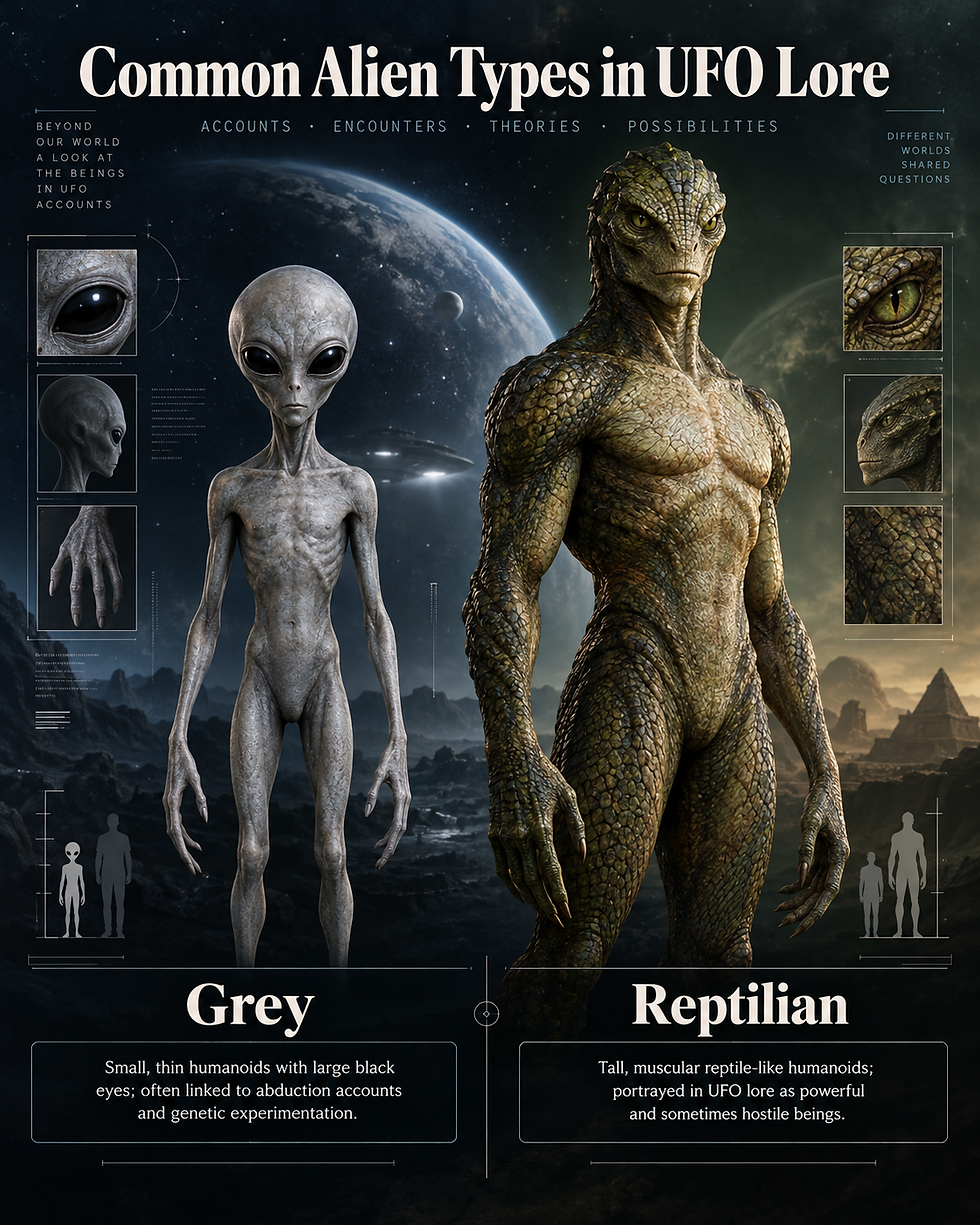
Unusually large, dark eyes
A sense of direct mental communication
A message about Earth, technology, and environmental damage
That last detail turned the case from a strange sighting into something more unsettling. Many witnesses said the beings communicated a warning. The message seemed to be that humanity was damaging the planet and becoming too careless with technology.
Paul Trim’s account fits within that broader pattern.
Paul Trim describes beings with dark eyes and a warning
Paul Trim was one of the Ariel School children who later spoke about the event. In his retelling, the object was not a vague light in the sky. It was a physical craft near the ground, shaped like the classic saucer image that has appeared in UFO reports for decades.
Trim has described seeing humanoid beings near the craft. As with other Ariel witnesses, the eyes became the feature that stayed with him.
Trim has described the figures as having “big black eyes,” with an appearance that felt human in basic shape, but clearly “not like us.”
That detail matters because it appears again and again in Ariel School witness accounts. The children did not simply report a machine. They described an encounter with beings whose gaze felt intense and direct.
Trim’s account also includes the craft’s sudden departure.
In retellings of the event, Trim has said the object “shot up” and left with startling speed, the kind of movement witnesses often describe as silent, instant, and unlike a normal aircraft.
The environmental message is the part that gives the story its emotional weight. Witnesses have described receiving images or impressions related to pollution, destruction, and the need to take better care of the planet. Some said it felt telepathic rather than spoken aloud.
That may sound impossible to some readers. It may sound familiar to anyone who has followed UFO contact cases, where messages about nuclear weapons, technology, or the environment appear often. Either way, the Ariel case is hard to dismiss as a simple rumor because so many children were interviewed close to the event, and many still stand by the core story as adults.
The strongest part of Trim’s account is not that every detail can be verified. It is that his memory aligns with a larger group account that has remained strikingly consistent in its main features for nearly three decades.
Why the environmental message keeps drawing attention
The Ariel School incident is often framed as a UFO landing case, but the warning may be the real reason it continues to resonate.
The children were not delivering a technical report about propulsion or materials. They were trying to explain an experience that felt bigger than sight alone. The beings, they said, seemed concerned with what humans were doing to Earth.
That message can be read in several ways.
A skeptic might say the children absorbed environmental themes from school, television, or adult conversations. By 1994, global concern over pollution, deforestation, and climate issues was already in public awareness. A group of children could have given shape to those fears through a shared story.
A believer might see the message as the point of the encounter. If an advanced non-human presence wanted to warn humanity, it might choose a direct emotional message rather than a diplomatic statement.
A more cautious reading sits between those positions. The Ariel witnesses clearly experienced something that affected them. Whether the source was external, psychological, social, or something stranger, the result was a lifelong memory linked to environmental responsibility.
That is why Paul Trim’s testimony still matters. It does not ask only, “What did they see?” It also asks, “Why would the message be about care, restraint, and survival?”
Georges St-Pierre’s interview brings in a new kind of witness
Georges St-Pierre is best known as one of the greatest mixed martial artists in UFC history. His name brings a very different audience into the UFO conversation. Fighters, trainers, and people on the road for fight-related events are not the usual characters in UFO documentaries. That makes the witness account shared through St-Pierre’s interview stand out.
In the interview, a new witness described a UFO encounter that happened while traveling with UFC fighters. The key detail is the setting. This was not a person alone in a remote field, telling a story no one else could place in context. The account involved travel, other people nearby, and a world where schedules, locations, and companions can often be checked.
The witness described seeing something in the sky that did not behave like a conventional aircraft. It was not presented as a simple distant star or a plane moving across the horizon. The account centered on movement and behavior that seemed wrong for known technology.
That is often what separates stronger UFO reports from weaker ones. A strange light by itself can have many explanations. A light or object that changes direction sharply, accelerates suddenly, stops without drifting, or appears near multiple observers becomes harder to explain.
St-Pierre’s role also matters. As a public figure with a reputation built on discipline and performance, he brings attention without needing to turn the subject into a spectacle. When serious athletes and people around them discuss unusual encounters, the topic reaches listeners who might otherwise ignore it.
The result is not proof. It is a broader witness pool.

U.S. government documents changed the frame
For decades, UFO witnesses carried a stigma. Many people stayed quiet because they feared ridicule, career damage, or being labeled unstable.
That has changed, at least partly, because the U.S. government has publicly acknowledged that some aerial incidents remain unexplained. The Pentagon has released or confirmed videos recorded by military pilots. Congress has held hearings. The term UAP has entered official use. Government reports have stated that many sightings likely have ordinary explanations, but some cases remain unresolved due to limited data.
Recent legislation and public discussions have also used language that once belonged mostly to science fiction, including references to “non-human intelligence” in draft policy debates and disclosure proposals. That does not mean the government has confirmed alien visitors. It means officials now treat the subject as serious enough to define, investigate, and debate in public.
This shift changes how stories like Paul Trim’s and the St-Pierre-linked witness account are received.
Ariel School is no longer just an old case from UFO lore. It can be compared with modern reporting patterns:
Multiple witnesses seeing the same unusual event
Objects described as moving in ways that appear unconventional
Witnesses struggling to explain what happened
A long-term emotional effect on those involved
Public reluctance followed by later testimony
The interview involving Georges St-Pierre fits the newer era. People who once might have stayed silent now have more permission to speak. The question is no longer whether UFO reports exist. The better question is which reports deserve careful review.
Testimony is powerful, but it has limits
Eyewitness testimony can be deeply moving. It can also be messy.
Memory changes over time. People fill in gaps. Group experiences can shape individual recall. Media attention can influence how stories are told later. These limits apply to all witness accounts, including famous UFO cases.
At the same time, dismissing every witness out of hand is not serious thinking. Some people report events with care, consistency, and no clear motive for attention. Many witnesses describe confusion rather than certainty. They do not always claim to know what they saw. They simply insist that it happened.
The Ariel School case remains striking because of the number of children involved and the speed with which interviews followed the event. The St-Pierre interview matters because it shows how newer witnesses are stepping forward in a climate where UAP reports are treated with less automatic ridicule.
The best approach is neither blind belief nor automatic dismissal. It is patient attention.
Ask clear questions:
How many people saw it?
Were they separated or together?
Did their descriptions match before media coverage?
Was there radar, video, audio, or location data?
Could it have been a drone, aircraft, balloon, meteor, satellite, or military exercise?
What parts of the story remain consistent over time?
Those questions do not drain the mystery from these accounts. They make the mystery sharper.
What these stories ask us to consider
The title Paul Trim and Georges St Pierre Reveal Shocking UFO Encounters and Non Human Warnings may sound dramatic, but the deeper issue is not shock. It is meaning.
If Paul Trim and other Ariel School witnesses are describing a real encounter, then the message was not about invasion or conquest. It was about responsibility. The beings, as described, did not arrive with weapons. They appeared, communicated concern, and left.
If the newer account shared through Georges St-Pierre’s interview reflects a real UAP sighting, then the phenomenon is not locked in the past. It is still being reported by people outside the usual UFO community, including those connected to high-profile sports and public life.
If both stories have conventional explanations, they still reveal something important. People across cultures and professions are seeing, interpreting, and remembering strange events through a shared question: are we alone, and are we listening closely enough?
The most responsible takeaway is simple. These accounts deserve curiosity without surrendering judgment.
Paul Trim’s memory of Ariel School keeps alive one of the most unusual mass UFO cases ever reported. The witness who spoke through Georges St-Pierre’s interview adds another thread to a growing public record. U.S. government documents have not answered the biggest questions, but they have made it harder to laugh those questions away.
And if the warning at Ariel School was truly about caring for the planet, then the message does not need a confirmed origin to matter. Human or non-human, earthly or unknown, it points toward the same uncomfortable truth: the way we treat this world is not a side issue. It may be the central test.