
Why is Tyler Perry Moving to Puerto Rico in 2027? His Lifestyle and Success Story
Updated: 6 days ago
Maria Rivera Garcia
Special to the St. Croix Times
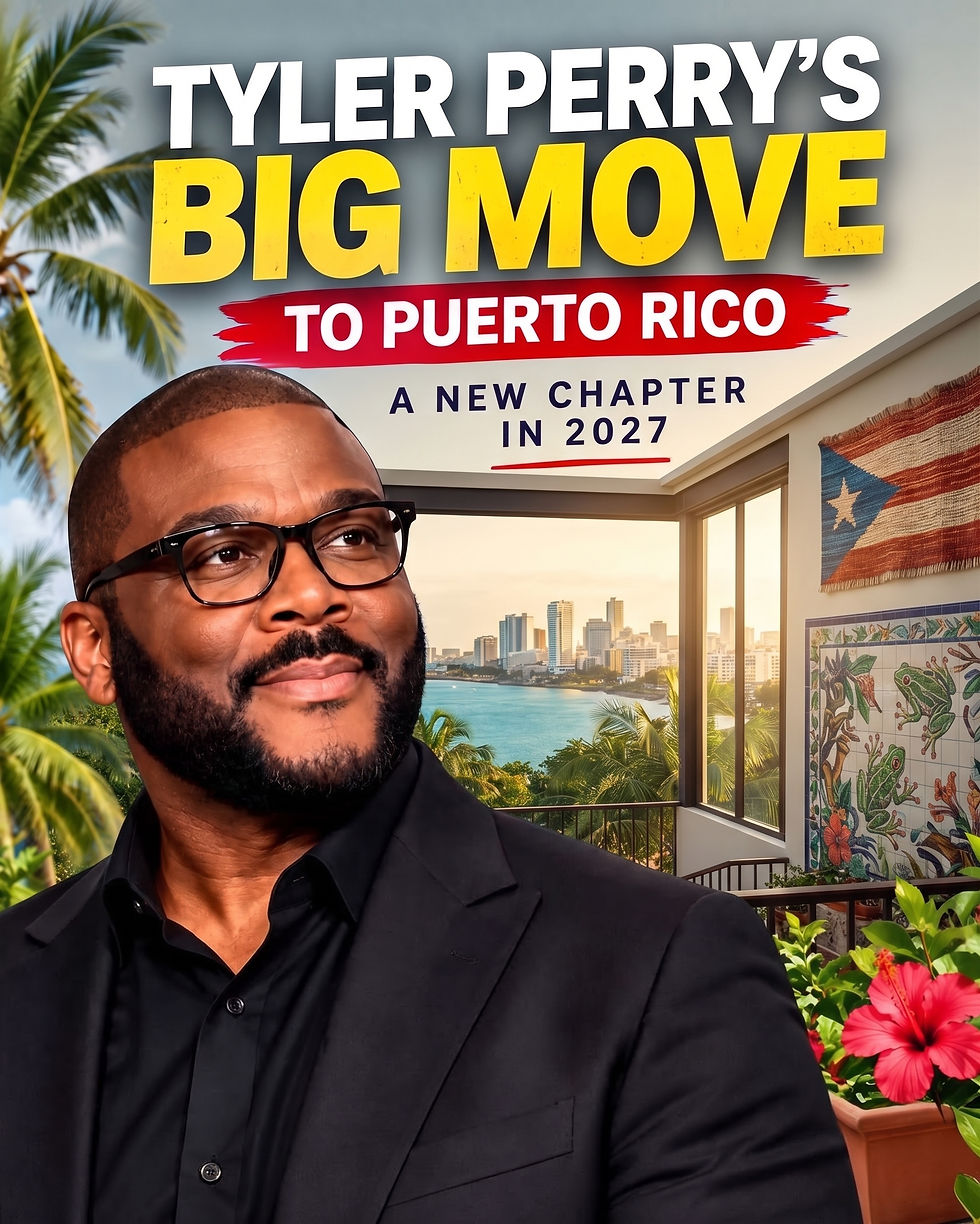
Old San Juan, PR - Tyler Perry has built one of the most independent entertainment empires in Hollywood. So when talk turns to a possible move to Puerto Rico in January 2027, it naturally raises more than a real estate question. It points to a bigger story about wealth, work, reinvention, and what life can look like after decades of nonstop creation.
If the relocation happens as expected, Perry would arrive in Puerto Rico at 57, at a stage when many high-achieving people start weighing time, privacy, health, taxes, family, and legacy with a sharper eye. For Perry, that does not appear to mean stepping away from film and television. It may instead mark a new chapter for a producer, writer, actor, and studio owner who has spent most of his adult life turning struggle into ownership.
Why Puerto Rico makes sense for Tyler Perry now
Puerto Rico has long attracted entrepreneurs, investors, entertainers, and remote business owners for a mix of practical and personal reasons. It offers Caribbean beauty while remaining closely tied to the United States. For someone like Tyler Perry, who controls a large body of work and has business interests that stretch across film, television, streaming, stage plays, and studio production, the island could offer both lifestyle appeal and financial planning options.
The timing matters. Perry turns 57 in September 2026, so a January 2027 move would come as he enters a different phase of life. At that age, priorities can shift. The question often changes from “What else can I build?” to “How do I want to live while I keep building?”
Puerto Rico offers answers that feel easy to understand:
Warm weather year-round
A slower daily rhythm than Los Angeles, New York, or Atlanta
Easy access to beaches and outdoor living
Proximity to the mainland United States
A strong cultural identity with music, food, architecture, and history
Potential tax planning benefits for people who qualify
For Perry, who has worked at an intense pace for decades, the appeal may be as much about breathing room as balance sheets.
Tax considerations could be part of the move
Any discussion of a high-net-worth move to Puerto Rico quickly turns to taxes. Puerto Rico has tax incentive programs under its current incentive framework, commonly associated with Act 60. These programs can offer benefits to certain qualifying individuals and businesses, including people who become bona fide residents and meet specific legal requirements.
That does not mean every person who moves to Puerto Rico receives the same benefits. The rules are detailed, and they depend on residency, income source, business structure, compliance, and timing. For U.S. citizens, Puerto Rico occupies a unique tax position because it is a U.S. territory, not a state. Some Puerto Rico-source income may be treated differently for federal tax purposes when a person qualifies as a bona fide resident.
That is likely why Puerto Rico has become part of conversations around wealth planning. For a creator and business owner like Perry, possible considerations could include:
How production income is structured
Where intellectual property income is earned
How future deals are managed
How residency rules affect personal taxes
How charitable giving and estate planning fit into long-term goals
This article is for general information only and is not tax, legal, or financial advice. A move of this scale would require experienced advisors who understand federal, Georgia, and Puerto Rico tax law.
Still, it is reasonable to see tax planning as one piece of the puzzle. Perry has created, owned, and distributed content at a level few entertainers ever reach. Protecting and managing that wealth would be part of any serious relocation decision.

Lifestyle may matter just as much as money
The tax story is easy to headline, but it can miss the human part. Perry’s career has involved years of writing scripts, producing shows, managing casts and crews, running a studio, acting in character, directing films, and handling public attention. That kind of life can be rewarding, but it is also demanding.
Puerto Rico could offer a different daily pattern. Mornings near the ocean. More privacy. A home environment that feels removed from the constant noise of the entertainment business. A place to host family and friends without being far from major U.S. cities by air.
That matters because Perry has often spoken publicly about the pain behind his success. His life story includes childhood trauma, homelessness, rejection, and years of financial uncertainty before his work found a wide audience. After building a career from the ground up, the desire for peace is not surprising.
A move to Puerto Rico in 2027 would not have to signal retreat. It could represent earned choice. Perry can live where he wants, work how he wants, and decide which projects deserve his time.
For people who have followed his career, that distinction is important. He has never behaved like someone waiting for permission. He has built systems that give him independence.
The rumors of retirement do not match his track record
Whenever a public figure makes a major life change, retirement rumors follow. In Perry’s case, those rumors can sound believable at first. He has already achieved historic success. He owns a major studio. He has created franchises, employed thousands of people, and made the kind of money that would allow him to stop working tomorrow.
But Perry has not built his career around slowing down. He has built it around control.
His work includes movies, television dramas, sitcoms, stage plays, and streaming projects. He has acted in his own productions and taken roles outside his own universe. He has written directly for audiences often overlooked by mainstream Hollywood. He has also created one of the most recognizable characters in modern popular entertainment, Madea.
Even when he has talked about stepping back from certain roles or characters, that has not meant leaving the industry. It has meant changing how he works.
That is the likely frame for Tyler Perry Moves to Puerto Rico in 2027 Tax Lifestyle and Success Story. The move may be less about ending a career and more about changing the base from which he creates.
Perry’s studio infrastructure in Atlanta gives him unusual freedom. He can produce at scale without needing to live full-time in the traditional entertainment capitals. In an era when creators can manage projects across multiple locations, living in Puerto Rico would not block him from making shows or films.
It may even help him choose more carefully.
From New Orleans hardship to national recognition
To understand why this possible move feels meaningful, it helps to look back at where Perry started.
Tyler Perry was born Emmitt Perry Jr. in New Orleans in 1969. His childhood was difficult, and he has spoken over the years about abuse, fear, and emotional pain. As a young man, he changed his first name to Tyler, a symbolic break from part of that past.
He did not enter entertainment through privilege or an easy industry pipeline. He found inspiration in writing, including the idea that putting painful experiences on paper could help process them. That practice led him toward theater.
His early stage work was not an immediate success. His play “I Know I’ve Been Changed” struggled at first. Perry invested his savings, faced empty seats, and endured years of financial instability. He has described periods when he lived in his car while trying to keep his dream alive.
That part of the story matters because Perry’s later success can look sudden from a distance. It was not. It came after years of failure, revision, touring, and direct connection with audiences.
He learned something many traditional studios missed. There was a large audience hungry for stories centered on Black families, faith, pain, forgiveness, comedy, and survival. Perry did not wait for Hollywood to validate that audience. He went to them through stage plays, churches, community venues, and word of mouth.

The milestones that changed everything
Perry’s rise can be traced through a series of turning points. Each one expanded his reach and gave him more control.
Milestone | Why it mattered |
Early stage plays | Perry built a loyal audience outside the traditional Hollywood system. |
Breakthrough tours | His plays became major draws, proving there was strong demand for his stories. |
Madea’s popularity | The character helped turn Perry into a household name and commercial force. |
“Diary of a Mad Black Woman” film | The 2005 movie introduced his storytelling to a wider film audience. |
Television success | Shows such as “House of Payne” helped make him a steady presence on TV. |
Studio ownership | Tyler Perry Studios gave him rare creative and business control. |
Streaming and network deals | New platforms allowed him to keep reaching audiences across formats. |
One of Perry’s biggest advantages has been ownership. He did not only perform. He wrote, produced, directed, and retained control over much of his work. That changed the economics of his career.
Hollywood has often rewarded performers while reserving the highest levels of wealth for owners, producers, rights holders, and studio heads. Perry became all of those.
His Atlanta studio became a symbol of that achievement. Built on a former military base, Tyler Perry Studios stands as one of the most significant Black-owned production facilities in the United States. It also moved the center of gravity for some film and television production away from Los Angeles.
That ownership is central to his freedom today. If Perry relocates to Puerto Rico, he is not leaving behind a career that depends on auditions or studio approval. He is moving as a creator with his own infrastructure.
Puerto Rico could shape the next creative chapter
Puerto Rico is more than a backdrop. It has its own film culture, local talent, architecture, beaches, forests, and urban energy. San Juan can look historic, modern, colorful, and cinematic within a few blocks. The island’s coastal towns offer visual texture that filmmakers value. El Yunque National Forest, Old San Juan, and the island’s beaches each carry a distinct mood.
For Perry, a Puerto Rico base could open creative doors, even if his main production work remains in Atlanta. It could inspire new settings, new partnerships, or simply a fresh rhythm for writing.
Many writers and producers rely on distance. Getting away from the machinery of production can make space for better ideas. A quieter home base may help Perry decide which stories still feel necessary.
A Puerto Rico chapter could also fit a larger shift in entertainment. The industry no longer revolves around one city. Productions happen in Georgia, New Mexico, Louisiana, New York, Canada, the Caribbean, and around the world. Streaming and cable deals can be managed across time zones. Talent moves constantly.
Perry has already shown that he does not need to follow the old map. Atlanta proved that. Puerto Rico could extend the same idea.

What the move would say about Perry’s legacy
Perry’s legacy is not only measured in box office totals or television episodes. It is measured in access.
He created roles for actors who were often ignored. He built productions that employed crews, writers, designers, drivers, caterers, editors, and technicians. He proved that audiences outside Hollywood’s usual assumptions could support major commercial success.
Critics have debated his style, themes, and creative choices for years. That debate is part of being influential. Perry’s work has never been neutral in popular culture. Some people see it as healing and familiar. Others find it broad or repetitive. What cannot be dismissed is the scale of what he built.
His career changed the business conversation around Black ownership in Hollywood. He showed that a creator could build a direct audience, own content, and turn independence into power.
That is why a move to Puerto Rico would be watched closely. It would be another choice made from a place of control. Not a disappearance. Not necessarily a goodbye. More likely, a life adjustment by someone who has earned the right to define success on his own terms.
A new address does not mean the final act
The idea of Tyler Perry moving to Puerto Rico in January 2027 brings together several themes at once. Taxes may play a role. Lifestyle almost certainly would. Age, privacy, wellness, and family could all matter. So could the chance to live somewhere beautiful while staying connected to a business he still influences deeply.
What seems less likely is a simple retirement story.
Perry’s career has never followed the expected script. He survived early failure, built an audience one city at a time, turned stage success into film and television power, and created a studio that changed what ownership could look like. Puerto Rico may become his next home base, but the larger story remains the same.
Tyler Perry is still shaping his life around independence. The setting may change to beaches, ocean air, and island mornings, but the work, the influence, and the legacy are still very much alive.


